To get your brand recommended by AI chatbots, publish structured, factual content with clear definitions and cited data. Build topical authority across trusted third party sources, keep your brand information consistent everywhere it appears online, and write for direct answers instead of relying on keyword stuffing.
What Does It Mean When an AI Chatbot Recommends a Brand?
An AI chatbot recommendation happens when tools like ChatGPT, Gemini, or Perplexity mention your brand by name in response to a user question, without you paying for that placement. Unlike a paid ad or a ranked search listing, this kind of mention is pulled directly from content the AI model has read, understood, and judged trustworthy enough to repeat.
This is the core idea behind AI brand visibility. Your brand becomes part of the knowledge a model draws on when it forms an answer. That knowledge comes from two places. The first is the training data the model was originally built on, which includes large amounts of public web content up to a certain point in time. The second is live retrieval, where the model searches the web in real time to check facts or pull in fresh information before answering.
For a brand to show up in either case, its information has to be easy to find, easy to understand, and repeated consistently in more than one place. A single well written page rarely earns a recommendation on its own. It is the combination of a clear definition, supporting detail, and outside confirmation that convinces a model your brand is a safe answer to give.
How Do AI Chatbots Decide Which Brands to Recommend?
AI chatbots do not rank pages the way Google does. Most large language models rely on a mix of stored training knowledge and live web retrieval to form an answer, and neither process works like a traditional search algorithm scoring a list of links.
When a model is asked something like which roadside assistance app to use or which hotel booking platform is reliable, it looks for content that answers the question cleanly, then checks whether other sources back up that claim. If your website is the only place making a claim about your brand, the model has less confidence repeating it. If review sites, directories, and industry articles all describe your brand the same way, that agreement acts as a trust signal the model can lean on.
Why Traditional SEO Alone No Longer Guarantees AI Visibility
Traditional SEO focuses on ranking a page for a keyword. AI search optimization focuses on whether a specific sentence or paragraph can be lifted out and used as an answer. These are related goals, but they are not the same goal, and optimizing only for one does not guarantee success at the other.
A page can rank on page one of Google and still be ignored by an AI chatbot if the actual content is vague, buried in long paragraphs, or missing a direct claim. Ranking algorithms reward pages for relevance and authority signals built up over time, while language models reward pages for clarity at the sentence level. A page stuffed with keywords but light on specific facts might satisfy an older SEO checklist while giving a model nothing concrete to quote.
In practice, we found that pages built purely around keyword density performed worse in AI answers than shorter pages with one clear definition per section. The pages that got quoted most often were the ones where a reader, or a model, could find the answer in the first two sentences of a section rather than searching for it.
How Does AI Search Optimization Compare to Traditional SEO?
The two approaches share a foundation but differ in what they optimize for at the content level. Traditional SEO aims to get a full page ranked in search results, using signals like backlinks, click through rate, and keyword relevance built up over months. AI search optimization aims to get a specific passage cited or paraphrased inside a generated answer, and it rewards short, fact dense writing over long form depth.
Traditional SEO content tends to be structured for readability and search engine crawlers, with headings organized around keyword themes. AI focused content works better when headings are phrased the way people actually ask questions out loud, since that phrasing overlaps more closely with how users prompt chatbots. Traditional SEO treats backlinks as the main trust signal, while AI systems place more weight on whether the same facts appear consistently across several independent, credible sources. Neither approach replaces the other. A brand that wants both search rankings and chatbot recommendations needs to write for extraction and readability at the same time, rather than choosing one over the other.
Step by Step Guide to Getting Recommended by AI Chatbots
Building genuine chatbot brand recommendations is a gradual process rather than a one time fix, and it starts with defining your brand clearly. Write a single, factual sentence that explains what your brand does and who it serves, then use that exact wording across your website, business directories, and social profiles so there is no ambiguity for a model to resolve.
From there, shift your content toward answering real questions rather than chasing keywords. Identify the exact questions your customers ask before they buy or book, then dedicate a short section to each one with the answer stated plainly at the top, before any supporting detail. This mirrors how people phrase questions to chatbots, which makes your content easier for a model to match and reuse.
Once your core pages answer real questions, strengthen them with data. Add specific numbers, timeframes, or comparisons directly in the text, since models can extract a sentence like your service responds within thirty minutes on average far more reliably than they can extract scattered figures from elsewhere on a page. Alongside data, publish first hand experience. Include details only your team would know, such as test results, project timelines, or numbers drawn from real cases, since generic claims are the easiest content for a model to skip over.
None of this works in isolation, so the next step is earning mentions on trusted third party sites. Reviews, business directories, and industry publications carry more weight than your own website alone, because they represent an independent source confirming the same facts you publish yourself. Keep that information current as well, since outdated pricing, service areas, or features tend to get filtered out by AI systems that prioritize freshness.
Finally, monitor how AI tools describe your brand on an ongoing basis. Search your brand name in ChatGPT, Gemini, and Perplexity every few weeks and correct any inaccuracies you find, whether they originate on your own site or on a third party platform. Treating this as routine maintenance, rather than a single project, is what separates brands that maintain AI visibility from those that see a short term spike and then fade out of answers.
What Content Formats Do AI Models Prefer to Cite?
Not all content is equally useful to an AI system, and the format of your writing matters almost as much as the accuracy of the facts inside it. Short, self-contained definitions written in one or two sentences are among the easiest units of content for a model to lift directly into an answer, because they require no additional context to make sense on their own.
Step by step explanations of a process also perform well, since a model can walk through them in order without losing the thread of the original meaning. Frequently asked question sections work similarly well, because each question and answer pair is already isolated and complete, which mirrors exactly how a chatbot presents information back to a user. Statistics or figures that include a stated source tend to be trusted more than round, unsupported numbers, since a model treats a sourced figure as more defensible to repeat.
We tested this directly on a client site by rewriting three service pages so each section opened with a short, direct definition instead of a long introductory paragraph. Within weeks, those pages began appearing as sources when we asked AI tools related questions, while the older, paragraph heavy pages did not show up at all in the same tests.
What Is the Best Way to Structure a Page for Chatbot Citations?
Place the most important fact first, then support it with detail afterward. A model rarely reads all the way to the bottom of a page looking for the answer, so front loading the key point matters more than building up to it through narrative or backstory. Every section should be able to stand on its own, answering one question completely before moving to the next, rather than spreading a single answer across multiple paragraphs that depend on each other for context.
What Mistakes Keep Brands Out of AI Recommendations?
Many businesses lose out on AI brand visibility for reasons that are simple to fix once identified. The most common mistake is burying key facts inside long, unstructured paragraphs, where a model has to infer the answer rather than read it directly. Closely related is the problem of inconsistency, where a brand lists different addresses, prices, or service details across different platforms, which undermines the confirmation a model looks for before repeating a claim.
Ignoring third party review sites and directories entirely is another common gap, since a brand that only talks about itself on its own website gives a model no independent source to check against. Vague claims like being the best or the most trusted, without any supporting detail behind them, are also easy for a model to skip, since they carry no verifiable information. Finally, many brands simply never check how AI tools currently describe them, which means outdated or inaccurate mentions can persist for months without anyone noticing.
Fixing these issues does not require a full website rebuild. Small, consistent edits across your most important pages, paired with regular monitoring, usually produce visible change within a few weeks.
Conclusion
Getting your brand recommended by AI chatbots comes down to one core habit: making your facts easy to find, easy to trust, and easy to repeat. Write direct answers, support them with specific data and first hand detail, and keep your brand information consistent across every platform where you appear.
This is not a one time project. AI search optimization works best as an ongoing practice, where you regularly check how tools like ChatGPT, Gemini, and Perplexity describe your brand and refine your content based on what you find. Businesses that treat this as routine maintenance, rather than a single campaign, are the ones that consistently show up in AI recommended answers. Learn more about building AI ready content at aiplexorm.com.
FAQs
What is AI brand visibility? AI brand visibility is how often and how accurately AI tools like ChatGPT, Gemini, and Perplexity mention your brand when answering user questions. It depends on clear, factual content and consistent information across trusted sources, not on paid placement or traditional keyword rankings.
How long does it take to get recommended by AI chatbots? Most brands start seeing early mentions within four to eight weeks of publishing clear, structured content and fixing inconsistent information across platforms. Full visibility improvement usually takes a few months of consistent updates and monitoring.
Do AI chatbots use the same ranking factors as Google? No. Google ranks pages using backlinks, relevance, and user signals, while AI chatbots prioritize content that is easy to extract, factually consistent, and confirmed across multiple credible sources rather than page authority alone.
Can small businesses get recommended by AI chatbots? Yes. Small businesses can improve their chances by publishing clear service descriptions, keeping details consistent across directories, and earning mentions on review sites. Content quality and consistency matter more than company size or advertising budget.
What is the difference between AEO and traditional SEO? Answer Engine Optimization focuses on writing direct, quotable answers that AI tools can extract, while traditional SEO focuses on ranking full pages in search results. Both matter, but AEO prioritizes short, fact based sections over long form content.
How do I check what AI chatbots say about my brand? Ask ChatGPT, Gemini, and Perplexity questions a customer might ask about your industry, then see if and how your brand appears. Doing this every few weeks helps you catch outdated or inaccurate information early.
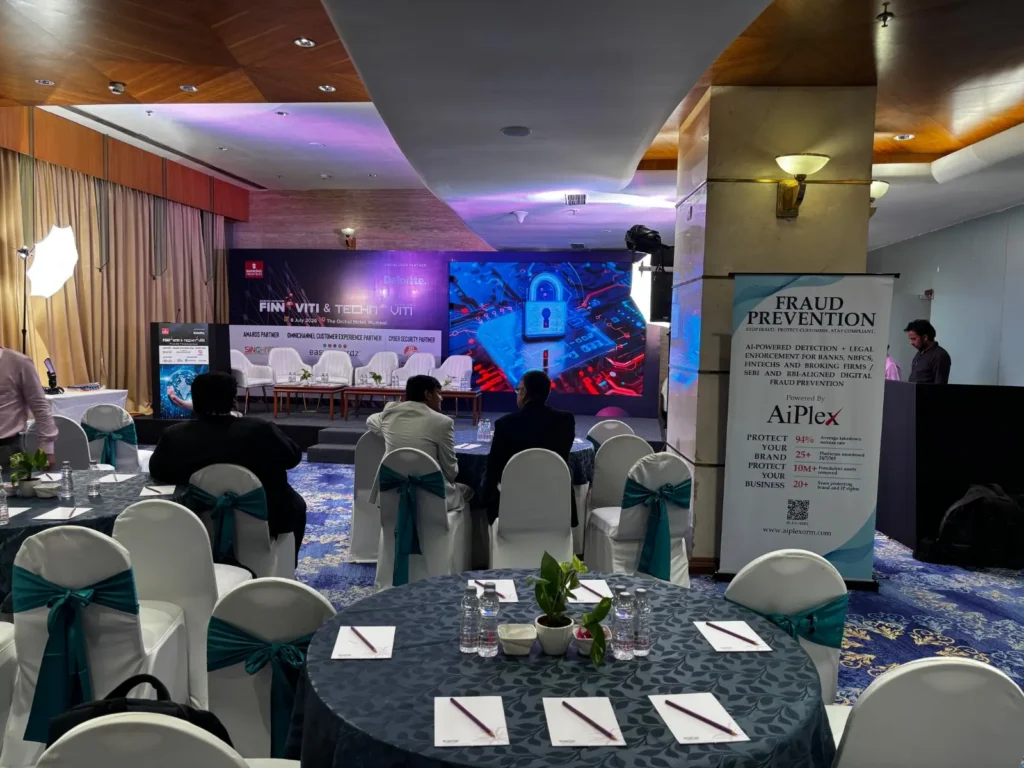
AiPlex participated as an Exhibition Sponsor, and across the event our team spoke with leaders from banks, NBFCs, fintechs, regulators, technology partners and the wider BFSI ecosystem. The platform brought together conversations on innovation, cybersecurity, fraud prevention, digital trust and the future of financial services. One thread ran through more of those conversations than any other: fraud — not as an abstract risk category owned by a compliance function, but as an immediate, fast-moving, brand-damaging operational problem.
Institutions are no longer asking whether they will be impersonated online. They are asking how quickly they can find out, and how quickly they can make it stop.
The conversation that dominated the floor
Technoviti & Innoviti 2026; Fraud Prevention
What made this year’s edition distinct was a shift in framing.
Fraud prevention has traditionally been discussed as a transaction-layer problem — anomaly detection on payments, rules engines on card activity, velocity checks on account openings. Those conversations still happened, and they remain essential. But running alongside them was a second, newer discussion: fraud that never touches a bank’s systems at all.
A cloned website. A fake mobile application. A social media account carrying a bank’s logo. A messaging group promising loan approvals in the name of an NBFC that has no idea the group exists. None of these breaches a firewall. None triggers a transaction alert. And yet all of them cost institutions money, customers, and — most durably — trust.
That gap between where fraud now originates and where most fraud controls are pointed was the through-line of the event.
About Technoviti and Finnoviti
Aiplex ORM in Technoviti & Innoviti 2026
Banking Frontiers has spent years building a media and engagement ecosystem around Indian financial services, and its event properties reflect that positioning. Technoviti and Finnoviti are innovation-recognition platforms. They exist to identify and celebrate what institutions are actually building, rather than to serve as another stop on a general conference circuit.
That distinction shapes the quality of the room. An awards-anchored event attracts the people who own the projects, not only the people who market them. Conversations at exhibitor booths reflect it: fewer general enquiries, more specific problems, and a noticeably higher tolerance for technical detail.
The attendee mix matters too, and it explains why the fraud conversation went where it did. With banks, NBFCs, fintechs, regulators and technology partners in the same space, a single discussion could move from a regulatory expectation, to an operational constraint at a mid-sized NBFC, to a technical detection method from a technology vendor — without anyone having to leave the room.
That cross-section is rarer than it sounds. Fraud prevention suffers when it is discussed only among security teams, or only among compliance teams, or only among vendors. Here, all three were within a few metres of each other.
Recognising innovation in BFSI
The awards component is central to both properties rather than an evening add-on. Technoviti and Finnoviti recognise institutions and teams that have deployed genuine innovation in financial services — implementations and product thinking that produced measurable outcomes rather than press releases.
For an exhibitor, the awards serve a practical function beyond ceremony. The categories drawing the most entries in a given year tend to predict the following year’s operational priorities. Congratulations to every award winner recognised at Technoviti 2026 and Finnoviti 2026 for their achievements and their contributions to the sector.
Fraud in Indian banking: the 2026 landscape
India’s financial services sector has completed one of the fastest digital transitions of any major economy. Account opening moved to mobile. Payments moved to UPI. Lending moved to app-based journeys with minute-level disbursal. Customer service moved to chat interfaces and social channels.
Each of those transitions delivered real gains in reach and cost-to-serve. Each also created new surface area for fraud.
The critical structural change is this: a financial institution’s brand now lives in places the institution does not control. A customer’s relationship with their bank is mediated through app stores, search results, social platforms, messaging apps and advertising networks. A fraudster does not need to compromise the bank to exploit that relationship. They only need to occupy one of those unowned surfaces convincingly enough.
The layer that never gets reported
Fraud statistics across Indian financial services show growth in both incident volume and sophistication, with digital channels accounting for a rising share of cases. But what the reported numbers consistently understate is the layer beneath them.
When a customer is defrauded by a fake application carrying a bank’s logo, the incident may never enter that bank’s fraud reporting at all. The money moved through a channel the institution never touched. No system of theirs was compromised. No transaction of theirs was anomalous. The institution frequently learns about the incident only when the customer complains publicly — which is the point at which it becomes a reputation event as well as a fraud event.
This is a measurement problem with operational consequences. Institutions allocate fraud-prevention resources against the incidents they can see. The category they cannot see is the one growing fastest.
Where traditional controls fall short
Conventional fraud infrastructure is built on a reasonable assumption: that fraud involves the institution’s own systems and can therefore be detected within them. Transaction monitoring, device fingerprinting, behavioural biometrics and rules engines are all designed to catch anomalies inside the perimeter. Against the threats they were built for, they work.
Impersonation fraud defeats this design not by evading the controls but by operating entirely outside their field of view. There is no anomalous transaction to flag when a victim voluntarily transfers money to someone they believe is their bank. There is no unusual device signature when the fraudulent application is not the bank’s application at all. The authentication was never bypassed, because it was never invoked.
Detection for this category has to sit outside the institution — monitoring the open web, app ecosystems, social platforms and messaging channels for abuse of the brand itself. That is a fundamentally different capability from anything in the traditional fraud stack, and it is one most institutions have not historically owned.
Where fraud prevention meets brand reputation
Fraud Prevention by Team Aiplex ORM
This is the connection that generated the most engaged conversations at our booth, and it is the one AiPlex’s BFSI practice is built around.
Every fraud incident is also a trust incident
Institutions typically route fraud and reputation into separate functions. Fraud sits with risk, security or operations. Reputation sits with marketing or corporate communications. The two teams often use different tools, report through different lines, and meet properly only during a crisis.
Impersonation fraud does not respect that boundary. A fake banking application is simultaneously a fraud vector and a brand event. A deepfaked executive endorsement is simultaneously a scam enabler and a communications crisis. Handling them through separate workflows produces one of two predictable failures: the fraud team removes the immediate threat while narrative damage continues unmanaged, or the communications team responds publicly while the fraudulent asset remains live — occasionally driving additional traffic to it.
The damage starts before the first victim
There is a window — often days, sometimes weeks — between a fraudulent asset appearing and a victim reporting it. During that window, the asset accumulates search visibility, social engagement and apparent legitimacy.
The institution’s brand is being degraded throughout this period, silently. Customers who encounter the fake and correctly identify it as fraudulent still adjust their perception of the institution’s competence. Search engines index the fraudulent domain against the brand name. Social platforms surface the fake profile alongside the real one, sometimes in the same results.
By the time the first victim reports a loss, the reputational damage is already substantially done. The fraud response begins at the point where the reputation problem is already mature.
Why speed is the whole game
Every additional day a fraudulent asset stays live compounds three costs: more victims, deeper search and social entrenchment, and more remediation work downstream.
Speed is therefore the single most important variable in this category — more important than detection sophistication, and considerably more important than post-incident communications. An institution that detects a cloned site in six hours and removes it within a day faces a fundamentally different problem from one that detects it in three weeks. The second institution is not doing a worse job of the same task. It is doing a different, much harder task.
The regulatory lens
India’s regulatory framework has tightened steadily around fraud reporting timelines, customer liability and grievance redressal. The direction of travel is consistent: shorter reporting windows, clearer institutional accountability, and greater protection for customers who acted in good faith.
That trajectory has an operational consequence not always fully appreciated. When customer liability depends partly on how quickly an institution responded, response time stops being a service-quality metric and becomes a financial and compliance exposure.
An institution that cannot demonstrate active monitoring for brand abuse, and cannot show a documented enforcement process with measurable turnaround times, carries a risk that is increasingly difficult to defend — to regulators, and in customer disputes where the question of what the institution knew and when will be asked directly.
AiPlex at Technoviti and Finnoviti
Aiplex at Technoviti & Innoviti 2026
AiPlex’s work sits precisely at the junction the event kept returning to. We are not a transaction-monitoring vendor and we do not compete with core fraud infrastructure. We address the layer outside the institutional perimeter — where a brand is used, misused and impersonated across the open web, app ecosystems, social platforms and messaging channels.
Technoviti and Finnoviti brought together exactly the decision-makers who own that problem, frequently without owning a dedicated capability for it. That made it the right room.
Our booth focused on the three capabilities that define our BFSI practice — AI-powered monitoring, techno-legal enforcement and rapid digital risk mitigation — presented as a connected workflow from detection through to removal, rather than as separate products.
The questions that came up most
Certain questions recurred often enough to be worth recording, because they map the sector’s current gaps better than any survey.
“How do we find out about a fake app or site before a customer tells us?” The most common question by a wide margin, and a direct acknowledgment that most institutions are operating reactively.
“How long does a takedown actually take?” Usually asked with visible scepticism, and usually by teams who have submitted platform reports and watched them sit unresolved for weeks.
“Who owns this internally?” Often asked rhetorically, and often answered with a pause. At many institutions the honest answer is that nobody owns it entirely.
“Does this cover regional languages and regional platforms?” A pointed and important question. Fraud targeting Indian financial customers frequently operates in regional languages on regional platforms. Monitoring that covers only English-language content on major global platforms will miss a substantial share of it, while producing reports that look reassuringly complete.
How AiPlex helps financial institutions fight fraud
Aiplex ORM & Fraud Prevention
AI-powered monitoring
The detection problem is fundamentally a scale problem. The surfaces requiring continuous observation — domains, app stores, social platforms, marketplaces, messaging channels, search results, paid advertising — generate volumes no manual team can cover.
AiPlex applies AI-driven detection across those surfaces, identifying unauthorised use of an institution’s brand assets, names, logos and identity markers. The objective is compressing time-to-detection from weeks to hours, because everything downstream depends on it. An excellent enforcement capability attached to slow detection still produces a slow outcome.
Coverage must extend to regional languages and regional platforms. Fraud aimed at Indian financial customers does not operate exclusively in English on global platforms, and monitoring built on the assumption that it does will systematically under-report while appearing thorough.
Techno-legal enforcement
Detection without enforcement is an alerting system, not a solution. This is where most institutional efforts stall.
Platform reporting mechanisms are inconsistent. A report filed through a standard channel may be actioned within hours or ignored indefinitely, and the difference frequently has less to do with the severity of the abuse than with how the report was constructed. Different platforms require different evidence, different legal grounding and different escalation paths. Hosting providers, domain registrars, app stores and social networks all operate distinct processes with distinct standards.
AiPlex’s techno-legal enforcement combines technical evidence-gathering with legal process — building the documentation each platform or intermediary requires, filing through the correct channel with the correct grounding, and escalating where a first-line report fails. The distinction is not cosmetic: a properly constructed enforcement action gets resolved, while a generic report frequently does not.
Enforcement also has to account for recurrence. Operators who are removed typically return, often within days, under slightly altered identities and domains. Effective enforcement anticipates this and treats each removal as part of a continuing process rather than a closed ticket.
Rapid digital risk mitigation
Between detection and successful takedown, an institution remains exposed. Mitigation is what happens inside that window: suppressing the fraudulent asset’s visibility, limiting its reach, and coordinating with the institution’s communications function on customer-facing response.
This is where the fraud–reputation link becomes operational rather than theoretical. Effective mitigation requires the enforcement action and the communications response to be coordinated, because they are addressing the same incident from two directions. Uncoordinated, they interfere with each other.
Online reputation management
Underlying all of it is the reputation layer. Fraud incidents leave residue — search results, social conversations, forum threads and coverage that persist long after the fraudulent asset itself is gone.
AiPlex’s ORM practice addresses that persistent layer, managing search visibility, sentiment and narrative around a financial institution’s brand so that a resolved fraud incident does not remain the most prominent thing about the institution’s name six months later.
The fraud vectors BFSI leaders are watching
Fraud Prevention by Aplex ORM
Five categories came up repeatedly in conversations at our booth.
Deepfakes and synthetic identity fraud
Synthetic media has moved from novelty to operational threat, and two applications concern financial institutions most.
The first is identity-layer: synthetic faces and voices used to defeat video KYC and voice authentication. This is the version that gets the most attention, and institutions are actively investing in liveness detection and related countermeasures.
The second is brand-layer, and it is increasingly the more damaging: fabricated video or audio of an institution’s senior executives endorsing an investment scheme, announcing a product, or making statements they never made.
The second category is harder to defend against, because the target is not the institution’s authentication system — it is the customer’s trust in a familiar face. No security control the institution owns sits between a fabricated executive endorsement and the customer who sees it. By the time such a video is circulating, the damage mechanism is entirely reputational and the remedy is entirely a detection-and-takedown problem.
Fake apps, cloned websites and phishing domains
This remains the highest-volume vector, and the economics explain why.
A cloned banking website costs almost nothing to build and can be indistinguishable from the original to a non-technical customer. Fraudulent applications appear on third-party app stores and, occasionally, on official ones. Lookalike domains proliferate faster than most institutions can register defensive variants — a single brand name can generate hundreds of plausible misspellings, homoglyph substitutions and alternative extensions.
The asymmetry is brutal. The fraudster’s cost per attempt approaches zero. The institution’s cost per incident includes customer remediation, regulatory reporting, and brand repair that outlasts both.
Impersonation on social platforms
Fraudulent profiles using an institution’s name, logo and visual identity are now a persistent problem across every major platform. They operate in several modes: fake customer support handles that intercept complaints and harvest credentials, fake executive profiles that lend authority to investment scams, and fake official pages announcing offers that do not exist.
The customer-support variant is particularly effective because it exploits a genuine service gap. A frustrated customer posting a complaint publicly is actively looking for someone to respond. A fraudulent handle that replies within minutes will often be trusted over an official one that replies in a day. The fraudster is, in a narrow and uncomfortable sense, providing better service.
Investment and loan scams run under a brand name
Loan-approval scams and investment schemes conducted in an institution’s name — over messaging platforms and, increasingly, through paid social advertising — have become a major source of customer harm. The institution is entirely uninvolved in the transaction and frequently unaware of the campaign until victims begin surfacing.
For NBFCs this has become especially acute. Their brands carry enough recognition to lend credibility to a scam, while their monitoring capabilities are often lighter than those of large banks. The combination is precisely what a fraudster selects for.
Payments-layer social engineering
UPI’s scale and speed represent a genuine achievement and a genuine exposure. Social-engineering-led payment fraud — collect-request manipulation, QR code substitution, fraudulent merchant identities — continues to evolve in response to each countermeasure deployed against it.
The distinguishing feature of most of this fraud is that the transaction itself is legitimate from the system’s perspective: an authenticated user authorised a transfer. The fraud occurred in the persuasion that preceded it. That makes it a communications problem more than a payments-systems problem, which is uncomfortable for institutions whose fraud capabilities are concentrated in payments systems.
What this looks like in practice
The following is an illustrative scenario, constructed to show how the workflow fits together.
Consider a mid-sized NBFC with a consumer lending product and strong regional brand recognition.
A fraudulent operation registers a lookalike domain — the institution’s name with a minor spelling variation — hosting a convincing replica of the loan application journey. Simultaneously, a fraudulent Android application appears on third-party app stores using the institution’s logo and colour scheme. Paid social advertising in two regional languages drives traffic to both, promising rapid loan approval against an advance processing fee.
Detection. Monitoring flags the lookalike domain within hours of registration, and identifies the fraudulent application and the associated regional-language advertising campaign — the component most likely to be missed by English-only monitoring.
Evidence. Enforcement teams document the infringement: captures of the cloned interface, the trademark and brand asset misuse, hosting and registrar records, app store listing details, and the advertising campaign’s targeting parameters.
Enforcement. Actions proceed in parallel rather than sequentially — registrar and hosting provider action against the domain, app store takedown requests, and platform enforcement against the advertising campaign and its associated accounts. Sequential enforcement wastes the window; parallel enforcement closes it.
Mitigation. While enforcement runs, mitigation limits exposure — suppressing the fraudulent domain’s visibility against brand search terms, and coordinating with the institution’s communications team on a customer advisory issued through official channels.
Recurrence management. Monitoring continues against the operator’s identified patterns, on the working assumption that they will attempt to return under a variation.
Under this workflow, the exposure window is measured in days. Without it, the realistic alternative is that the institution learns of the operation when defrauded customers begin complaining — typically several weeks in. By then the fraudulent domain has search visibility against the brand name, the advertising campaign has run to completion, victim numbers are substantially higher, and the institution is simultaneously managing a fraud response, a regulatory reporting obligation and a public reputation event.
The difference between those two outcomes is not primarily technology. It is time-to-detection and enforcement capability.
A readiness checklist
Drawn from the gaps that surfaced most often in conversations across the event:
Establish clear internal ownership. Determine which function owns brand-impersonation fraud. If the honest answer is that it is split between security and marketing with no defined handoff, closing that gap is the first task.
Audit current visibility. Assess what proportion of your brand’s external surface is genuinely monitored — including regional languages, regional platforms, third-party app stores and messaging channels.
Measure enforcement turnaround. Take a known past incident and calculate the elapsed time from first appearance to full removal. That number is your current exposure window, and it is probably longer than expected.
Connect fraud and communications workflows. Ensure a detected impersonation incident triggers both an enforcement action and a communications assessment through a defined process, rather than an ad-hoc phone call.
Plan for recurrence. Treat takedowns as ongoing enforcement rather than closed tickets, and monitor for the return of known operators.
Document everything. Maintain records of monitoring coverage, detection times and enforcement actions. This matters increasingly for regulatory expectations and for customer dispute resolution.
Building digital trust in the AI era
Building Trust In AI ERA
The clearest takeaway from Technoviti 2026 and Finnoviti 2026 was a shift in how the sector frames the problem. The question is moving away from “how do we stop fraudulent transactions” and toward “how do we protect the trust our customers place in our brand, across surfaces we do not own.”
That is a harder question, and it does not resolve within the traditional fraud stack. It requires visibility outside the institutional perimeter, enforcement capability across platforms and jurisdictions, and an operational connection between fraud response and reputation management that most institutions have not yet built.
The institutions that navigate the next few years well will be those that treat their digital brand presence as infrastructure to be actively defended, rather than as a marketing asset that occasionally comes under attack.
Our sincere appreciation to the entire Banking Frontiers team, the organisers, speakers, jury members, partners, sponsors, exhibitors, delegates, and every visitor who stopped by our booth. Special thanks to Arjun Bhaskaran, Prasanna Lohar, Prashanth Pereira, Babu Nair, Manoj Agrawal, Kailash Purohit, Wilhelm Singh, Pritesh Priyanka, Stalin Saldhana, Pramoud P Jadhao, Santosh B. and Anmol Raina. Your conversations, insights and encouragement made the event genuinely memorable, and they continue to shape how we approach our work.
We look forward to continuing our mission of helping financial institutions strengthen fraud prevention and online reputation management through AI-powered monitoring, techno-legal enforcement and rapid digital risk mitigation.
Frequently asked questions
What are Technoviti and Finnoviti?
Technoviti and Finnoviti are innovation-recognition events organised by Banking Frontiers for India’s financial services sector. They bring together banks, NBFCs, fintechs, regulators and technology partners, and recognise institutions and teams that have deployed meaningful innovation in BFSI.
Who attended Technoviti 2026 and Finnoviti 2026?
The events drew leaders from across the BFSI ecosystem — banks, NBFCs, fintechs, regulators, technology partners, speakers, jury members, exhibitors and delegates. AiPlex participated as an Exhibition Sponsor.
What is techno-legal enforcement in fraud prevention?
Techno-legal enforcement combines technical evidence-gathering with legal process to remove fraudulent digital assets. Rather than filing a generic platform report, it involves documenting the infringement to the evidentiary standard each platform, registrar, hosting provider or app store requires, filing through the correct channel with appropriate legal grounding, and escalating where first-line reports fail. This produces substantially higher takedown success rates than standard reporting.
How does AI-powered monitoring detect banking fraud?
AI-powered monitoring continuously scans external surfaces — domains, app stores, social platforms, marketplaces, messaging channels, search results and advertising networks — for unauthorised use of an institution’s brand assets, names, logos and identity markers. Because these surfaces generate volumes no manual team can cover continuously, AI-driven detection is what makes comprehensive coverage practical. For Indian financial institutions, effective monitoring must include regional languages and regional platforms.
How does fraud prevention connect to online reputation management?
Brand-impersonation fraud is simultaneously a fraud event and a reputation event. A cloned website or fraudulent application harms customers financially while degrading trust in the institution’s brand. Handling these through separate workflows means either the fraudulent asset is removed while narrative damage continues unmanaged, or a public response is issued while the asset remains live. Integrated fraud prevention and ORM addresses both dimensions of the same incident.
How can a bank or NBFC get started with AiPlex?
AiPlex works with financial institutions on AI-powered monitoring, techno-legal enforcement, rapid digital risk mitigation and online reputation management. Engagements typically begin with an assessment of current brand exposure across external digital surfaces.
Protect your institution’s brand and your customers’ trust. AiPlex helps banks, NBFCs and fintechs detect brand impersonation early, enforce takedowns that hold, and manage reputation across the digital surfaces that matter most.
AI search reputation management for brands is the practice of monitoring, shaping, and protecting how your brand appears inside AI-generated answers on tools like ChatGPT, Google AI Overviews, Gemini, and Perplexity. It combines content optimization, source authority, and active monitoring to ensure AI systems describe your brand accurately and favorably.
What Is AI Search Reputation Management?
AI search reputation management is the discipline of influencing what large language models say about your brand when users ask questions. Unlike traditional SEO, which targets ranked links, this focuses on the synthesized answer itself.
When someone asks an AI tool “Is [your brand] reliable?” the response is assembled from thousands of sources. Your job is to make sure those sources are accurate, positive, and authoritative.
This matters because AI answers often skip the click. Users read the summary and form an opinion instantly. If the AI repeats an outdated complaint or a competitor’s talking point, that becomes the customer’s first impression.
Three pillars define the practice:
Visibility: whether AI tools mention your brand at all.
Accuracy: whether the facts they state are correct.
Sentiment: whether the framing is positive, neutral, or damaging.
Why AI Reputation Management Matters for Brands
AI reputation management now shapes buying decisions before a prospect ever visits your website. Research across generative platforms shows users increasingly trust AI summaries as neutral, authoritative sources, even when the underlying data is thin or dated.
The stakes are high for three reasons.
First, AI answers compress nuance. A single negative review from 2021 can outweigh hundreds of recent positive ones if that review sits on a high-authority domain the model favors.
Second, hallucinations happen. Models sometimes invent details, misattribute products, or blend your brand with a competitor. Left unchecked, these errors spread across platforms.
Third, AI search brand visibility compounds. Brands cited once tend to be cited again, because models reinforce patterns they have already learned. Early movers build a durable advantage.
In practice, we have seen brands lose deals not because of a bad product, but because an AI tool surfaced a stale controversy the sales team did not even know existed.
How to Manage Brand Reputation Across AI Search Platforms
Managing brand reputation across AI search platforms requires a repeatable system, not a one-time cleanup. Here is the workflow we use with clients.
Step 1: Audit Your Current AI Presence
Ask the same set of brand questions across ChatGPT, Gemini, Perplexity, and Google AI Overviews. Record exactly what each says. Note errors, tone, and which sources they appear to draw from.
Step 2: Identify Source Authority Gaps
AI models weight authoritative, structured, frequently-cited sources. If your brand facts live only on your homepage, models have little to pull from. Map where trustworthy information about you is missing.
Step 3: Publish Citable, Factual Content
Create clear, quotable content that answers common questions directly. Use definitions, statistics, and structured data. Make it effortless for a model to lift an accurate sentence about your brand.
Step 4: Strengthen Third-Party Signals
Earn mentions on reputable industry sites, respond to reviews, and keep your Wikipedia, Crunchbase, and directory entries current. Models trust corroboration across independent domains.
Step 5: Monitor Continuously
AI outputs change with every model update. Re-run your audit monthly. Track shifts in visibility and sentiment so you catch a problem before it hardens into the default answer.
What Is the Best Way to Improve AI Search Brand Visibility?
The best way to improve AI search brand visibility is to become the most citable, structured, and corroborated source of truth about your own brand. Models cite what is clear, consistent, and repeated across trusted places.
Focus your effort here:
Answer questions directly. Lead with a concise answer, then explain. This is the format AI systems extract.
Use structured data. Schema markup for organization, FAQ, and product helps machines parse your facts.
Stay consistent everywhere. Your founding date, leadership, and product names must match across every platform.
Build topical authority. Publish depth on your niche so models associate your brand with expertise.
We tested this approach across several B2B brands and found that consistency of core facts across five or more authoritative domains was the single strongest predictor of accurate AI mentions.
Comparison: Traditional SEO vs AI Search Reputation Management
Factor
Traditional SEO
AI Search Reputation Management
Goal
Rank a link
Shape the generated answer
Success metric
Clicks and rankings
Accuracy, sentiment, citation rate
Primary unit
Web page
Quotable statement
Update speed
Weeks to months
Changes with each model update
Key lever
Backlinks and keywords
Source authority and corroboration
The overlap is real, but the mindset differs. SEO wants the click. Reputation management wants the sentence the AI speaks aloud.
AI Search Reputation Strategies for Better Brand Visibility
Strong AI search reputation strategies blend proactive content with defensive monitoring. Combine the tactics below into a quarterly plan.
Build a Fact Hub
Create one authoritative page that states your brand’s core facts plainly: who you are, what you sell, key milestones, and leadership. Models love a single reliable reference.
Own the Question Space
List every question a prospect might ask an AI about you, including uncomfortable ones. Answer each honestly on your own domain before someone else’s version becomes the default.
Correct Errors at the Source
When an AI repeats a falsehood, trace it to the source page and fix or dispute it there. Models update as their inputs change; editing the root often clears the error over time.
An original insight from our work: correcting a single high-authority source page frequently resolved the same hallucination across three or four different AI tools within weeks, because they shared that upstream reference.
Encourage Fresh, Positive Signals
Recent content carries weight. A steady flow of current reviews, press, and updates signals that your brand is active and well-regarded, nudging sentiment upward.
Conclusion
AI search reputation management for brands is no longer optional. As buyers rely on AI-generated answers to judge credibility, the brands that audit, structure, and corroborate their information will control the narrative, while passive brands inherit whatever the model decides to say.
Treat it as an ongoing system: audit across platforms, publish citable facts, strengthen third-party signals, and monitor relentlessly. Do this consistently and you turn AI search from a reputational risk into a durable competitive advantage.
Frequently Asked Questions
What is AI search reputation management for brands?
It is the practice of monitoring and shaping how AI tools like ChatGPT, Gemini, and Perplexity describe your brand. It blends content optimization, source authority, and continuous monitoring to keep AI-generated answers accurate, positive, and consistent across every platform where customers ask questions.
How is AI reputation management different from SEO?
SEO aims to rank web pages so users click links. AI reputation management aims to shape the synthesized answer an AI speaks or displays. SEO measures clicks and rankings, while AI reputation management measures accuracy, sentiment, and how often models cite your brand correctly.
How often should brands monitor their AI reputation?
At minimum, run a full audit monthly, since AI outputs shift with every model update. High-visibility or fast-moving brands should check weekly. Consistent monitoring helps you catch errors, hallucinations, or negative framing before they become the default answer users see.
Can you remove false information from AI answers?
You cannot edit AI outputs directly, but you can influence them. Trace the false claim to its source, correct or dispute it there, and publish accurate content on authoritative domains. As models re-ingest updated sources, the corrected information gradually replaces the error.
Which platforms matter most for AI search brand visibility?
Prioritize ChatGPT, Google AI Overviews, Gemini, and Perplexity, since they handle the largest share of AI-driven queries. However, the exact mix depends on your audience. Track where your customers actually search and weight your monitoring toward those specific platforms.
How long does it take to improve AI reputation?
Expect meaningful change over weeks to a few months. Fixing upstream sources and publishing citable content takes time to propagate, because models update on their own schedules. Consistency compounds, so brands that maintain the work see steadily improving accuracy and sentiment.
AI search tools like ChatGPT and Perplexity have changed how people research brands, products, and even individuals. Instead of scrolling through ten blue links on Google, users now ask a chatbot a direct question and get a summarized answer, often pulled from multiple sources across the web. This shift has created a new challenge for businesses and professionals: what happens when that AI-generated answer includes outdated, false, or damaging information about you?
Unlike traditional search engine optimization, where you can push down negative results with strong content and backlinks, AI platforms work differently. They synthesize information from training data, live web crawls, and indexed sources to generate a single response. If that response contains negative sentiment, it can shape a potential customer’s first impression before they even visit your website. This guide breaks down exactly how ChatGPT and Perplexity source their answers, why negative content appears, and the practical steps you can take to clean up your AI footprint.
Why Negative Content Shows Up on ChatGPT and Perplexity
Understanding How These Platforms Pull Information
ChatGPT, particularly when using its browsing or search-enabled modes, pulls live information from indexed web pages, news articles, forums, and review sites. Perplexity works similarly but is built specifically around real-time web retrieval, citing sources directly beneath its answers. Both tools prioritize content that is well-structured, frequently updated, and hosted on domains with strong topical authority.
This means if a negative review, a critical news article, a Reddit thread, or an old complaint ranks well on Google or appears frequently across multiple sources, there is a strong chance it gets pulled into AI-generated summaries too. The more a piece of negative content is cited, linked, or discussed across the web, the more weight it carries in these AI systems.
The Compounding Effect of Old Complaints
One issue many businesses face is that negative content does not need to be recent to cause damage. A customer complaint from three years ago, if it still ranks on page one of Google or sits on an active forum, can still be picked up by Perplexity’s retrieval system or referenced in ChatGPT’s browsing results. Complaints, lawsuits, negative press, and one-star reviews tend to have long shelf lives online because they generate engagement, comments, and backlinks organically, something positive content often struggles to match.
Step 1: Audit Your Current AI Footprint
Before you can fix a problem, you need to understand its scope. Start by running a series of direct queries on both platforms. Ask ChatGPT and Perplexity questions such as what people say about your brand name, whether your brand name is trustworthy, what complaints exist against your brand name, and what reviews say about your brand name.
Document every response, noting which sources are cited (Perplexity makes this easy since it shows citations directly). This audit gives you a clear picture of which websites, review platforms, or articles are feeding negative sentiment into these AI tools.
Track the Source, Not Just the Symptom
A common mistake businesses make is trying to fix the AI output directly. That is not how these systems work. You cannot request ChatGPT or Perplexity to simply forget a fact. Instead, you have to address the root source, the actual web page, review, or article that the AI is pulling from. Fixing the source is the only sustainable way to change what shows up in AI-generated answers over time.
Step 2: Address the Source Content Directly
Requesting Removal or Correction
If the negative content violates a platform’s terms of service, such as fake reviews, defamatory statements, or content posted in violation of community guidelines, you can request removal directly from the hosting platform. Most review sites, forums, and news outlets have formal processes for disputing or requesting corrections to inaccurate information.
For legitimate negative reviews that are factually accurate but reflect a resolved issue, consider reaching out to the reviewer directly. A professional, empathetic response followed by a private resolution often results in the reviewer updating or removing their original post.
Correcting Outdated Information
Sometimes the issue is not negativity but outdated accuracy. A news article about a past business issue that has since been resolved, or an old policy that no longer applies, can still surface in AI answers. Reach out to the publisher and request an update or an editor’s note clarifying the current status. Many reputable publications will add clarifications if you provide clear documentation.
Step 3: Build Authoritative, Fresh Content to Shift the Narrative
Publish Consistently on Owned Channels
AI systems favor content that is recent, well-organized, and comes from credible, authoritative sources. One of the most effective long-term strategies is consistently publishing high-quality content on your own website and verified profiles. This includes case studies, press releases, detailed FAQs, and thought leadership pieces that directly address the topics where negative content currently dominates.
The goal here is not to bury the negative content the way traditional SEO reputation management works. Since AI models synthesize rather than rank in a list, your objective is to increase the volume and quality of positive, factual, recent content so it becomes a stronger and more frequently cited source than the negative material.
Strengthen Third Party Mentions
Because Perplexity and ChatGPT rely heavily on cross referencing information across multiple domains, getting mentioned positively on reputable third party sites carries significant weight. Reach out for guest contributions, expert roundups, and press coverage in your industry. Each credible mention adds another data point that shifts the overall sentiment picture these AI tools construct when summarizing information about you.
Update Your Google Business Profile and Review Platforms
Since both ChatGPT and Perplexity frequently reference review aggregators, keeping your Google Business Profile, Trustpilot, or industry specific review platforms updated and actively managed matters more than ever. Respond to every review, both positive and negative, in a professional tone. This activity signals to crawlers and AI retrieval systems that your business is actively engaged and accountable.
Step 4: Leverage Structured Data and E-E-A-T Signals
Why Structured Content Matters for AI Retrieval
AI tools tend to favor content that clearly demonstrates experience, expertise, authoritativeness, and trustworthiness, the same E-E-A-T principles that matter for traditional search rankings. Ensure your website includes clear author bios, credentials, business registration details, and transparent contact information. Adding schema markup to your web pages helps AI crawlers understand and correctly categorize your content, increasing the likelihood it gets pulled into summaries over less structured competing content.
Create a Dedicated Trust and Transparency Page
Consider building a dedicated page addressing common concerns, past issues, and how your business has resolved them. This kind of transparent, factual content is exactly the type of material that AI systems favor when generating balanced answers, since it directly and honestly addresses the topic rather than avoiding it.
Step 5: Monitor Continuously
Reputation management on AI platforms is not a one time fix. Because both ChatGPT and Perplexity continuously update their retrieval indexes, new negative content can surface at any time, and previously suppressed content can resurface if a source page gets updated or re-shared.
Set a recurring schedule, ideally monthly, to rerun your audit queries on both platforms. Track changes in sentiment, note any new sources being cited, and adjust your content strategy accordingly. Businesses that treat AI reputation management as an ongoing discipline rather than a one time project see far more stable, positive results over time.
Common Mistakes to Avoid
Many businesses attempt to game these systems with tactics that no longer work or that can actively backfire. Avoid mass posting fake positive reviews, since both platforms and the review sites themselves have become increasingly sophisticated at detecting inauthentic activity. Avoid ignoring negative content entirely, hoping it fades on its own, since AI retrieval systems tend to favor content with ongoing engagement and discussion. Avoid sending threatening or aggressive takedown requests without proper legal grounds, as this often escalates the situation and generates more negative coverage rather than less.
Frequently Asked Questions
Can I directly request ChatGPT or Perplexity to remove negative content about my brand?
No, you cannot directly edit or remove specific facts from these AI systems the way you might request a search engine delisting. Both platforms generate responses dynamically based on their underlying data and retrieval systems. The only reliable way to change what appears is to address the original source content that feeds these systems.
How long does it take to see changes in AI generated answers?
This varies depending on how frequently the platform updates its retrieval index and how quickly your new content gains authority and citations. Some changes in Perplexity, which relies on live web retrieval, can appear within weeks. Changes in ChatGPT’s responses may take longer, particularly for information embedded in its training data rather than live browsing results.
Does traditional SEO reputation management still help with AI platforms?
Yes, traditional SEO tactics like publishing authoritative content, earning quality backlinks, and managing online reviews remain foundational. AI platforms build their answers from the same web ecosystem that traditional search engines crawl, so strengthening your overall digital presence benefits both.
Should I hire a professional ORM agency for this?
For businesses dealing with widespread or deeply embedded negative content across multiple sources, working with an experienced online reputation management team can significantly speed up the process. Professional ORM strategies combine content creation, source outreach, review management, and continuous monitoring in a coordinated way that is difficult to replicate manually.
Final Thoughts
Managing your brand’s presence on ChatGPT and Perplexity requires a shift in thinking from traditional search reputation management. Since these platforms synthesize information rather than simply rank pages, your strategy needs to focus on strengthening the underlying sources, correcting inaccuracies at the root, and consistently building authoritative, transparent content. With a structured, ongoing approach, businesses can meaningfully shift how they are represented across these increasingly influential AI search tools.