Personal reputation management is the ongoing practice of shaping how people and search engines perceive you online. It combines monitoring your name, building positive content, and responding to feedback so your personal online reputation reflects your real character. In 2026, it protects careers, businesses, and trust across both search results and AI answers.
What Is Personal Reputation Management?
Personal reputation management is the practice of monitoring, shaping, and protecting how you are perceived online and offline. It covers what appears when someone searches your name, what people say about you, and how consistently your identity shows up across the web.
At its simplest, your reputation is the sum of what a stranger finds in the first few seconds of looking you up. Personal reputation management makes sure that picture is accurate, positive, and within your control.
Here is a definition you can quote: personal reputation management is the process of influencing public perception of an individual by monitoring mentions, building trusted content, and correcting misinformation across search and social platforms.
Personal Reputation Management vs Personal Branding
People often confuse the two, but they are not the same. Personal branding is what you actively project: your voice, your expertise, and the story you choose to tell. Personal reputation is what others believe about you once that story reaches them.
Branding is the message you send. Reputation is the message received. Strong personal reputation management aligns the two, so that your personal brand reputation matches how the world actually experiences you.
The Building Blocks of a Personal Online Reputation
A personal online reputation rests on a few core assets. These include your search results for your own name, your social profiles, reviews and mentions on independent sites, news coverage, and increasingly the way AI assistants summarise you.
When these assets agree with each other and reflect your real character, trust builds quickly. When they conflict or fall silent, doubt fills the gap. The aim of online reputation management is to keep every one of those signals working in your favour.
Why Does Personal Reputation Management Matter for Professionals and Executives?
For working professionals and executives, reputation is currency. Clients, employers, investors, and partners search your name before a meeting, and what they find shapes the decision before you ever enter the room. A search result has quietly become the modern reference check.
Personal reputation management for professionals and executives protects that first impression. A doctor with a clean, informative profile earns patient trust. A founder with credible coverage raises funding more easily. A senior leader with a consistent presence signals stability to a board.
In our work at AiPlex ORM, we have seen strong candidates lose opportunities over a single outdated article or a mismatched profile. The problem is rarely a lack of merit. It is that the online story was left unmanaged while everything else was polished.
Reputation also compounds. A professional who invests early holds an advantage that grows year after year, while someone who ignores it spends far more later trying to repair damage that steady attention would have prevented.
How Do You Manage Your Personal Online Reputation?
Learning how to manage your personal online reputation comes down to a repeatable cycle of audit, build, monitor, and respond. Most people act only after something goes wrong, but the real value sits in doing this work before a crisis appears.
Step One: Audit and Monitor Your Name
Start by searching your own name the way a stranger would, in a private browser window, across the first three pages of results and on the major social platforms. Note what ranks, what is missing, and what feels off.
Then set up alerts so new mentions reach you quickly. Ongoing monitoring turns reputation from a yearly panic into a quiet, manageable habit. You cannot manage what you never see.
Step Two: Build and Own Positive Content
Once you know the gaps, fill them with content you control. A personal website, a well written professional profile, published articles, interviews, and genuine social activity all give search engines credible material to rank.
The goal is not vanity. It is ownership. Every strong property you publish is one more result that reflects your intended story, rather than leaving that space to chance or to critics.
Choosing Platforms Worth Owning
Not every platform deserves your energy. Prioritise the ones that rank well for personal names and that you can update freely. A personal domain, a major professional network profile, and one or two publishing platforms usually outperform a scattered presence across a dozen accounts you never maintain.
Depth beats width. Three well kept properties build more trust than fifteen abandoned ones, and they are far easier to keep consistent over time.
Step Three: Respond to Criticism Without Making It Worse
Not all criticism deserves a reply, and knowing the difference is a skill. Genuine feedback deserves a calm, professional response. Malicious or false content often needs a quieter, more strategic approach through the platform itself or through legal channels.
In practice, we have seen a single defensive comment turn a minor complaint into a lasting search result. The instinct to fight publicly usually feeds the very content you were hoping to bury.
Best Personal Reputation Management Strategies for 2026
The most effective personal reputation management strategies share one trait. They are proactive. Waiting until a problem ranks on the first page is the hardest and most expensive place to begin.
Our first original insight is simple but often ignored. The strongest defense is a content moat, a cluster of trusted properties that you own and that consistently rank for your name. When enough positive results occupy the first page, no single negative item can dominate the story. Building this moat while things are calm is far easier than clearing wreckage later.
A second strategy is consistency of identity. Your name, title, photo, and key facts should match everywhere they appear. Search engines and AI systems treat consistent signals as trustworthy and conflicting ones as suspect. A mismatched job title across profiles is a small thing to a human but a real problem for a machine trying to read who you are.
The third strategy is patience. Reputation is built in layers over months, not days. The professionals with the calmest search results are almost always the ones who started early and simply kept going.
How Is AI Reshaping Personal Reputation Management?
This is the shift that defines 2026, and it is our second original insight. Your reputation is no longer read only by people. It is read by machines that summarise you on demand.
When someone asks an AI assistant about you, the model does not open your website and admire it. It gathers fragments from across the web and produces a short, confident summary. If those fragments are consistent and credible, the summary flatters you. If they conflict or are thin, the answer turns vague, outdated, or simply wrong.
This makes entity consistency the new center of gravity for online reputation management. The question is no longer only what ranks on Google, but what an AI concludes when it stitches your scattered mentions together into a single sentence.
The practical takeaway is that you now write for two audiences at once. Humans judge tone and depth. Machines judge consistency and clarity. A modern personal online reputation has to satisfy both, because the AI summary is increasingly the true first impression, formed before anyone clicks a single link.
Common Personal Reputation Management Mistakes to Avoid
Even careful people trip over the same errors, and most are avoidable. The first is silence. Publishing nothing leaves the space open for others to define you, and empty search results tend to read as a lack of credibility.
The second is overreacting to negatives. Fighting every critic in public can trigger the Streisand effect, where the attempt to hide something draws far more attention to it. Restraint is often the stronger move.
The third is inconsistency. Abandoned profiles, outdated titles, and contradictory bios quietly erode trust with both readers and AI systems. A profile you never update can hurt you more than one you never created.
At AiPlex ORM, the pattern we see most often is delay. People know their online presence needs attention, yet they wait until a crisis forces their hand. By then the repair costs far more time, money, and stress than steady maintenance ever would.
Frequently Asked Questions
What is personal reputation management?
Personal reputation management is the practice of monitoring and shaping how you are perceived online. It involves tracking your name in search results, building positive content you control, and responding to feedback so your personal online reputation stays accurate and trustworthy across search engines, social platforms, and AI generated answers.
How do I check my online reputation?
Search your full name in a private browser window and review the first three pages of Google, along with the major social platforms and image results. Note what ranks, what is missing, and what looks inaccurate. Setting up name alerts lets you monitor new mentions continuously instead of checking only once in a while.
How long does personal reputation management take?
Reputation work is gradual. Small improvements can appear within a few weeks, but a stable, positive presence usually takes several months of consistent content and monitoring. Repairing serious damage takes longer still. The professionals with the calmest results are almost always the ones who started early and stayed consistent.
Can I remove negative content about myself online?
Sometimes, but not always. Genuinely false or policy violating content can often be reported and removed through the platform or legal routes. Truthful but unflattering content is much harder to erase. In those cases, the better strategy is to build stronger positive results that outrank the negative one over time.
Is personal reputation management only for celebrities?
No. Anyone searchable online has a reputation to manage, and that now includes almost everyone. Professionals, executives, business owners, and job seekers all benefit, because clients and employers routinely search names before making decisions. In many ways private individuals gain the most, since they start with a blank slate to shape.
How does AI affect my personal reputation?
AI assistants now summarise people by combining mentions from across the web. If your information is consistent and credible, the summary works in your favour. If it conflicts or is sparse, the answer becomes vague or wrong. Keeping your identity consistent everywhere is now essential to a healthy online reputation.
Conclusion
Personal reputation management in 2026 is no longer optional for anyone whose name can be searched. It is the steady work of monitoring your presence, owning credible content, staying consistent across every profile, and responding to criticism with restraint rather than reaction. The advantage goes to those who act early, before a problem forces their hand, and who treat both people and AI systems as the audience reading their story. If you want expert help building and protecting your personal online reputation, the team atAiPlex ORM can guide you from the first audit to lasting results.
Personal reputation management for CEOs is the strategic process of monitoring, protecting, and shaping an executive’s online image across search results, social platforms, and news media. It combines proactive content creation, review oversight, and crisis response so that what people find about a leader reflects their true credibility and authority.
What Is Personal Reputation Management for CEOs?
Personal reputation management for CEOs refers to the ongoing practice of controlling how a business leader appears online. It covers everything from Google search results and Wikipedia entries to LinkedIn profiles, press coverage, and interview mentions that surface when someone types the executive’s name.
For executives, reputation is inseparable from the company they lead. A significant share of a company’s perceived value is tied to how its CEO is viewed by the public. When a leader’s name is searched, the first page of results acts as a digital resume, a trust signal, and sometimes a liability that follows them into every boardroom and negotiation.
Executive reputation management differs from ordinary personal branding because the stakes reach further. A single misleading article, lawsuit mention, or viral post can influence investors, board members, employees, and customers at the same moment, often before the leader is even aware of it.
Why CEO Reputation Management Matters More Than Ever
The digital footprint of a CEO now travels faster and further than at any point in business history. AI search tools, news aggregators, and social media have compressed the time between an event and public judgment to a matter of minutes.
Consider the practical weight of this. Shareholders research leadership before committing capital, and hesitation at that stage can quietly cost a funding round. Top candidates evaluate a CEO before accepting an offer, meaning a weak or outdated presence can lose the very talent a company needs. Vendors and partners vet executives online before signing, and a single unmanaged incident can dominate search results for years.
In practice, we have watched executives lose deals not because of poor performance, but because outdated or misleading search results created doubt at exactly the wrong time. Reputation has quietly become a business asset that behaves like any other, gaining value when tended and losing it when ignored.
How Do You Build a Strong Executive Reputation Online?
Building executive reputation management credibility is a structured process rather than a one time effort. The framework below moves from understanding your current position to actively strengthening it.
It begins with an honest audit. Search your own name in incognito mode across Google, Bing, and AI tools like ChatGPT and Perplexity, then document everything that appears across the first two pages. This baseline reveals the gaps, outdated content, and vulnerabilities you are actually working with, rather than the version you imagine exists.
From there, the work shifts to claiming and optimizing the assets you control. A personal website, a verified LinkedIn profile, authenticated social accounts, and author bios on trusted publications all tend to rank well and give you direct authority over your narrative. These owned properties become the anchor of everything that follows.
The next layer is authoritative content. Thought leadership articles, recorded interviews, and speaking engagements build the topical authority that both search engines and AI models reward when deciding what to surface and cite. Finally, third party validation seals the effort. Media mentions, podcast appearances, and industry recognition carry more weight than any self published claim because they arrive from independent sources that readers instinctively trust.
What Are the Best Personal Reputation Management Strategies for CEOs?
The most effective CEO reputation management strategies for digital credibility work on two fronts at once, building strength before problems arise and responding decisively when they do.
On the proactive side, the goal is a foundation so solid that negativity struggles to gain traction. This means maintaining an active professional presence with regular insights, contributing guest articles to respected publications, keeping a personal website that ranks for your own name, and holding a consistent narrative across every platform where you appear. Consistency here is not cosmetic. It is what allows both people and algorithms to recognize you as a single, coherent authority.
The reactive side handles threats as they emerge. Real time alerts for your name and company give you the earliest possible warning. Quick, professional responses to legitimate criticism prevent small issues from calcifying, and strengthening positive assets naturally pushes unwanted content down the results. When a matter crosses into defamation, experienced legal counsel becomes part of the toolkit rather than an afterthought.
One insight drawn directly from our work stands out here. Executives who publish consistently for six months or longer show markedly more resilience during a crisis, because the deep reserve of positive content they have built quietly absorbs the impact and keeps negative results from ever reaching the top.
DIY Versus Professional Reputation Management
Many leaders wrestle with whether to manage their reputation personally or bring in specialists, and the honest answer depends on where they are in their journey.
A do it yourself approach carries low upfront cost and works reasonably well when a public profile is still modest. The trade off is time and speed. Progress tends to be slow and gradual, expertise is limited to what the executive can learn on their own, and crisis handling stays purely reactive because there are no systems watching in the background. Suppressing established negative content through DIY methods is genuinely difficult, and the personal effort required is substantial.
Professional services flip most of those variables. The investment is higher, but results arrive faster, backed by specialized teams and proactive monitoring systems that catch issues early. Advanced suppression techniques become available, and the demand on the executive’s own time drops to a minimum. Most leaders begin with the DIY route and transition to professional personal reputation management services for CEOs once their public profile grows or a crisis exposes the limits of going it alone.
How Long Does It Take to Improve a CEO’s Online Reputation?
Reputation change is gradual by nature. Building positive visibility typically takes three to six months, while suppressing established negative content can require six to twelve months or longer depending on how entrenched it is.
The timeline hinges on the strength of existing negative material, the authority of your owned assets, and how consistently new content is published. There are no legitimate overnight fixes, and any service promisinginstant removal of negative results should be treated with real caution.
A second insight worth carrying forward concerns how AI tools now operate. These systems weigh source consistency heavily, so when your bio, credentials, and messaging align across every platform, AI models become far more likely to cite you accurately and favorably. Fragmented information, by contrast, invites the errors that quietly erode trust.
Conclusion
Personal reputation management for CEOs is no longer optional in a world where search results and AI tools shape first impressions long before any meeting takes place. A strong executive reputation protects investor confidence, attracts talent, and builds the kind of lasting business trust that compounds over time.
The most successful leaders treat reputation as an ongoing asset, combining proactive content, third party validation, and rapid crisis response into a single discipline. Whether managed in house or through professional support, consistency is what separates resilient reputations from vulnerable ones. Start with an honest audit, secure the assets you own, and build authority steadily. At Aiplexorm, we help executives take control of their digital credibility with tailored reputation management strategies built for long term impact.
Frequently Asked Questions
What is personal reputation management for CEOs?
It is the strategic practice of monitoring and shaping how a CEO appears online across search results, social media, and news. It protects credibility, supports business goals, and ensures accurate information reaches the investors, employees, and partners searching for that leader.
How much do CEO reputation management services cost?
Costs vary widely with scope, ranging from a few thousand dollars monthly for basic monitoring to considerably more for crisis response and content suppression. Pricing reflects the complexity of existing issues, the number of platforms managed, and the level of ongoing support the executive requires.
Can negative search results about a CEO be removed?
Most negative results cannot be deleted unless they violate laws or platform policies. Instead, reputation management suppresses them by strengthening positive, authoritative content that ranks higher, gradually pushing unwanted material off the visible first page where most people stop looking.
How is executive reputation management different from personal branding?
Personal branding focuses on promotion and visibility, while executive reputation management balances promotion with protection. It adds monitoring, crisis response, and search suppression, addressing both the building of a positive image and the defense against threats that could harm business outcomes.
Why do investors care about a CEO’s online reputation?
Investors view leadership as a key risk factor. A CEO’s online reputation signals stability, competence, and integrity. Negative or inconsistent information raises doubt about judgment and governance, which can directly influence funding decisions, valuations, and long term shareholder confidence.
How often should a CEO monitor their online reputation?
Executives should monitor continuously through automated alerts and review results manually at least monthly. High profile leaders or those in volatile industries benefit from weekly checks, allowing rapid response to emerging issues before they gain momentum across search and social media.
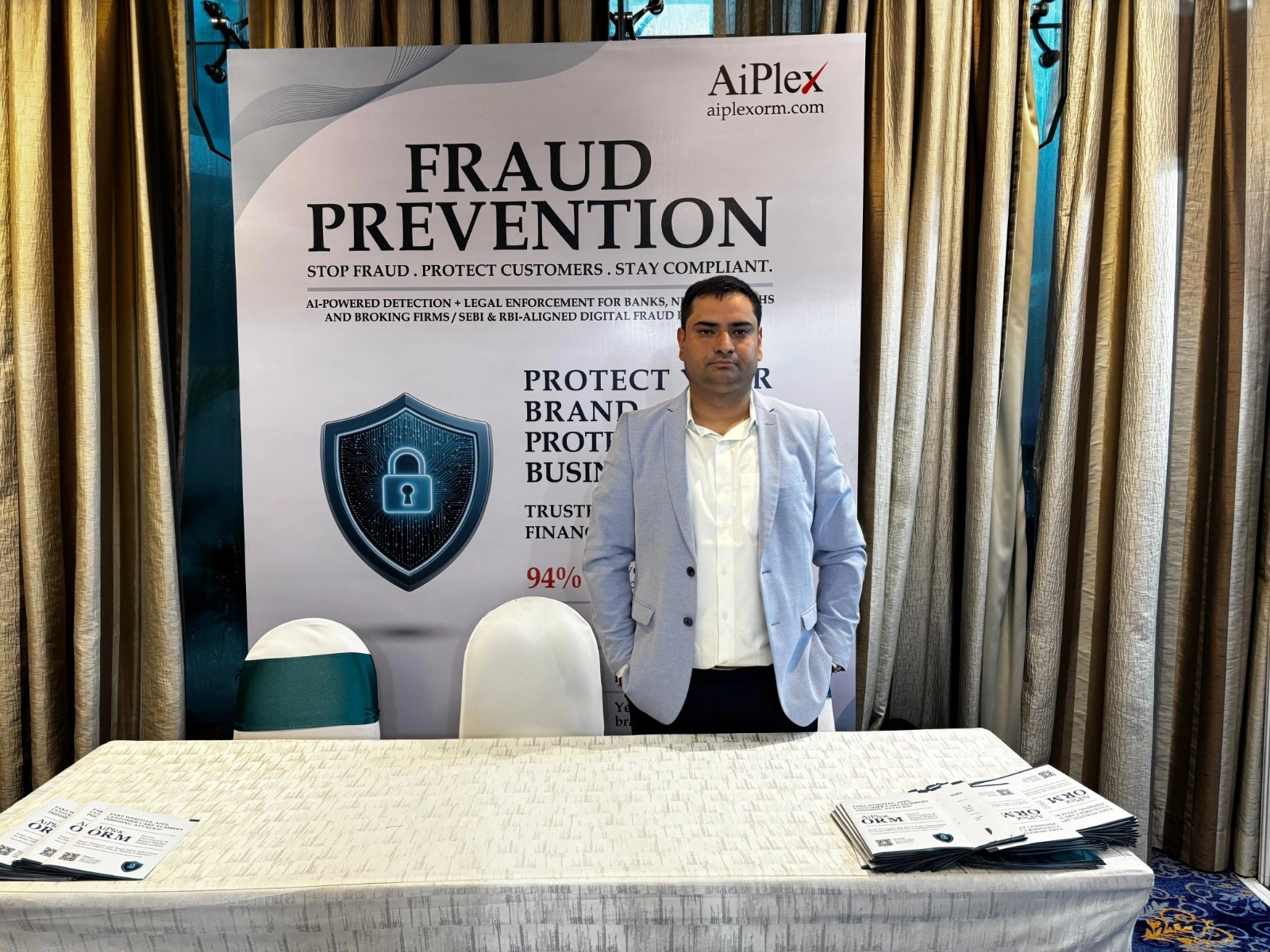
AiPlex participated as an Exhibition Sponsor, and across the event our team spoke with leaders from banks, NBFCs, fintechs, regulators, technology partners and the wider BFSI ecosystem. The platform brought together conversations on innovation, cybersecurity, fraud prevention, digital trust and the future of financial services. One thread ran through more of those conversations than any other: fraud — not as an abstract risk category owned by a compliance function, but as an immediate, fast-moving, brand-damaging operational problem.
Institutions are no longer asking whether they will be impersonated online. They are asking how quickly they can find out, and how quickly they can make it stop.
The conversation that dominated the floor
Technoviti & Innoviti 2026; Fraud Prevention
What made this year’s edition distinct was a shift in framing.
Fraud prevention has traditionally been discussed as a transaction-layer problem — anomaly detection on payments, rules engines on card activity, velocity checks on account openings. Those conversations still happened, and they remain essential. But running alongside them was a second, newer discussion: fraud that never touches a bank’s systems at all.
A cloned website. A fake mobile application. A social media account carrying a bank’s logo. A messaging group promising loan approvals in the name of an NBFC that has no idea the group exists. None of these breaches a firewall. None triggers a transaction alert. And yet all of them cost institutions money, customers, and — most durably — trust.
That gap between where fraud now originates and where most fraud controls are pointed was the through-line of the event.
About Technoviti and Finnoviti
Aiplex ORM in Technoviti & Innoviti 2026
Banking Frontiers has spent years building a media and engagement ecosystem around Indian financial services, and its event properties reflect that positioning. Technoviti and Finnoviti are innovation-recognition platforms. They exist to identify and celebrate what institutions are actually building, rather than to serve as another stop on a general conference circuit.
That distinction shapes the quality of the room. An awards-anchored event attracts the people who own the projects, not only the people who market them. Conversations at exhibitor booths reflect it: fewer general enquiries, more specific problems, and a noticeably higher tolerance for technical detail.
The attendee mix matters too, and it explains why the fraud conversation went where it did. With banks, NBFCs, fintechs, regulators and technology partners in the same space, a single discussion could move from a regulatory expectation, to an operational constraint at a mid-sized NBFC, to a technical detection method from a technology vendor — without anyone having to leave the room.
That cross-section is rarer than it sounds. Fraud prevention suffers when it is discussed only among security teams, or only among compliance teams, or only among vendors. Here, all three were within a few metres of each other.
Recognising innovation in BFSI
The awards component is central to both properties rather than an evening add-on. Technoviti and Finnoviti recognise institutions and teams that have deployed genuine innovation in financial services — implementations and product thinking that produced measurable outcomes rather than press releases.
For an exhibitor, the awards serve a practical function beyond ceremony. The categories drawing the most entries in a given year tend to predict the following year’s operational priorities. Congratulations to every award winner recognised at Technoviti 2026 and Finnoviti 2026 for their achievements and their contributions to the sector.
Fraud in Indian banking: the 2026 landscape
India’s financial services sector has completed one of the fastest digital transitions of any major economy. Account opening moved to mobile. Payments moved to UPI. Lending moved to app-based journeys with minute-level disbursal. Customer service moved to chat interfaces and social channels.
Each of those transitions delivered real gains in reach and cost-to-serve. Each also created new surface area for fraud.
The critical structural change is this: a financial institution’s brand now lives in places the institution does not control. A customer’s relationship with their bank is mediated through app stores, search results, social platforms, messaging apps and advertising networks. A fraudster does not need to compromise the bank to exploit that relationship. They only need to occupy one of those unowned surfaces convincingly enough.
The layer that never gets reported
Fraud statistics across Indian financial services show growth in both incident volume and sophistication, with digital channels accounting for a rising share of cases. But what the reported numbers consistently understate is the layer beneath them.
When a customer is defrauded by a fake application carrying a bank’s logo, the incident may never enter that bank’s fraud reporting at all. The money moved through a channel the institution never touched. No system of theirs was compromised. No transaction of theirs was anomalous. The institution frequently learns about the incident only when the customer complains publicly — which is the point at which it becomes a reputation event as well as a fraud event.
This is a measurement problem with operational consequences. Institutions allocate fraud-prevention resources against the incidents they can see. The category they cannot see is the one growing fastest.
Where traditional controls fall short
Conventional fraud infrastructure is built on a reasonable assumption: that fraud involves the institution’s own systems and can therefore be detected within them. Transaction monitoring, device fingerprinting, behavioural biometrics and rules engines are all designed to catch anomalies inside the perimeter. Against the threats they were built for, they work.
Impersonation fraud defeats this design not by evading the controls but by operating entirely outside their field of view. There is no anomalous transaction to flag when a victim voluntarily transfers money to someone they believe is their bank. There is no unusual device signature when the fraudulent application is not the bank’s application at all. The authentication was never bypassed, because it was never invoked.
Detection for this category has to sit outside the institution — monitoring the open web, app ecosystems, social platforms and messaging channels for abuse of the brand itself. That is a fundamentally different capability from anything in the traditional fraud stack, and it is one most institutions have not historically owned.
Where fraud prevention meets brand reputation
Fraud Prevention by Team Aiplex ORM
This is the connection that generated the most engaged conversations at our booth, and it is the one AiPlex’s BFSI practice is built around.
Every fraud incident is also a trust incident
Institutions typically route fraud and reputation into separate functions. Fraud sits with risk, security or operations. Reputation sits with marketing or corporate communications. The two teams often use different tools, report through different lines, and meet properly only during a crisis.
Impersonation fraud does not respect that boundary. A fake banking application is simultaneously a fraud vector and a brand event. A deepfaked executive endorsement is simultaneously a scam enabler and a communications crisis. Handling them through separate workflows produces one of two predictable failures: the fraud team removes the immediate threat while narrative damage continues unmanaged, or the communications team responds publicly while the fraudulent asset remains live — occasionally driving additional traffic to it.
The damage starts before the first victim
There is a window — often days, sometimes weeks — between a fraudulent asset appearing and a victim reporting it. During that window, the asset accumulates search visibility, social engagement and apparent legitimacy.
The institution’s brand is being degraded throughout this period, silently. Customers who encounter the fake and correctly identify it as fraudulent still adjust their perception of the institution’s competence. Search engines index the fraudulent domain against the brand name. Social platforms surface the fake profile alongside the real one, sometimes in the same results.
By the time the first victim reports a loss, the reputational damage is already substantially done. The fraud response begins at the point where the reputation problem is already mature.
Why speed is the whole game
Every additional day a fraudulent asset stays live compounds three costs: more victims, deeper search and social entrenchment, and more remediation work downstream.
Speed is therefore the single most important variable in this category — more important than detection sophistication, and considerably more important than post-incident communications. An institution that detects a cloned site in six hours and removes it within a day faces a fundamentally different problem from one that detects it in three weeks. The second institution is not doing a worse job of the same task. It is doing a different, much harder task.
The regulatory lens
India’s regulatory framework has tightened steadily around fraud reporting timelines, customer liability and grievance redressal. The direction of travel is consistent: shorter reporting windows, clearer institutional accountability, and greater protection for customers who acted in good faith.
That trajectory has an operational consequence not always fully appreciated. When customer liability depends partly on how quickly an institution responded, response time stops being a service-quality metric and becomes a financial and compliance exposure.
An institution that cannot demonstrate active monitoring for brand abuse, and cannot show a documented enforcement process with measurable turnaround times, carries a risk that is increasingly difficult to defend — to regulators, and in customer disputes where the question of what the institution knew and when will be asked directly.
AiPlex at Technoviti and Finnoviti
Aiplex at Technoviti & Innoviti 2026
AiPlex’s work sits precisely at the junction the event kept returning to. We are not a transaction-monitoring vendor and we do not compete with core fraud infrastructure. We address the layer outside the institutional perimeter — where a brand is used, misused and impersonated across the open web, app ecosystems, social platforms and messaging channels.
Technoviti and Finnoviti brought together exactly the decision-makers who own that problem, frequently without owning a dedicated capability for it. That made it the right room.
Our booth focused on the three capabilities that define our BFSI practice — AI-powered monitoring, techno-legal enforcement and rapid digital risk mitigation — presented as a connected workflow from detection through to removal, rather than as separate products.
The questions that came up most
Certain questions recurred often enough to be worth recording, because they map the sector’s current gaps better than any survey.
“How do we find out about a fake app or site before a customer tells us?” The most common question by a wide margin, and a direct acknowledgment that most institutions are operating reactively.
“How long does a takedown actually take?” Usually asked with visible scepticism, and usually by teams who have submitted platform reports and watched them sit unresolved for weeks.
“Who owns this internally?” Often asked rhetorically, and often answered with a pause. At many institutions the honest answer is that nobody owns it entirely.
“Does this cover regional languages and regional platforms?” A pointed and important question. Fraud targeting Indian financial customers frequently operates in regional languages on regional platforms. Monitoring that covers only English-language content on major global platforms will miss a substantial share of it, while producing reports that look reassuringly complete.
How AiPlex helps financial institutions fight fraud
Aiplex ORM & Fraud Prevention
AI-powered monitoring
The detection problem is fundamentally a scale problem. The surfaces requiring continuous observation — domains, app stores, social platforms, marketplaces, messaging channels, search results, paid advertising — generate volumes no manual team can cover.
AiPlex applies AI-driven detection across those surfaces, identifying unauthorised use of an institution’s brand assets, names, logos and identity markers. The objective is compressing time-to-detection from weeks to hours, because everything downstream depends on it. An excellent enforcement capability attached to slow detection still produces a slow outcome.
Coverage must extend to regional languages and regional platforms. Fraud aimed at Indian financial customers does not operate exclusively in English on global platforms, and monitoring built on the assumption that it does will systematically under-report while appearing thorough.
Techno-legal enforcement
Detection without enforcement is an alerting system, not a solution. This is where most institutional efforts stall.
Platform reporting mechanisms are inconsistent. A report filed through a standard channel may be actioned within hours or ignored indefinitely, and the difference frequently has less to do with the severity of the abuse than with how the report was constructed. Different platforms require different evidence, different legal grounding and different escalation paths. Hosting providers, domain registrars, app stores and social networks all operate distinct processes with distinct standards.
AiPlex’s techno-legal enforcement combines technical evidence-gathering with legal process — building the documentation each platform or intermediary requires, filing through the correct channel with the correct grounding, and escalating where a first-line report fails. The distinction is not cosmetic: a properly constructed enforcement action gets resolved, while a generic report frequently does not.
Enforcement also has to account for recurrence. Operators who are removed typically return, often within days, under slightly altered identities and domains. Effective enforcement anticipates this and treats each removal as part of a continuing process rather than a closed ticket.
Rapid digital risk mitigation
Between detection and successful takedown, an institution remains exposed. Mitigation is what happens inside that window: suppressing the fraudulent asset’s visibility, limiting its reach, and coordinating with the institution’s communications function on customer-facing response.
This is where the fraud–reputation link becomes operational rather than theoretical. Effective mitigation requires the enforcement action and the communications response to be coordinated, because they are addressing the same incident from two directions. Uncoordinated, they interfere with each other.
Online reputation management
Underlying all of it is the reputation layer. Fraud incidents leave residue — search results, social conversations, forum threads and coverage that persist long after the fraudulent asset itself is gone.
AiPlex’s ORM practice addresses that persistent layer, managing search visibility, sentiment and narrative around a financial institution’s brand so that a resolved fraud incident does not remain the most prominent thing about the institution’s name six months later.
The fraud vectors BFSI leaders are watching
Fraud Prevention by Aplex ORM
Five categories came up repeatedly in conversations at our booth.
Deepfakes and synthetic identity fraud
Synthetic media has moved from novelty to operational threat, and two applications concern financial institutions most.
The first is identity-layer: synthetic faces and voices used to defeat video KYC and voice authentication. This is the version that gets the most attention, and institutions are actively investing in liveness detection and related countermeasures.
The second is brand-layer, and it is increasingly the more damaging: fabricated video or audio of an institution’s senior executives endorsing an investment scheme, announcing a product, or making statements they never made.
The second category is harder to defend against, because the target is not the institution’s authentication system — it is the customer’s trust in a familiar face. No security control the institution owns sits between a fabricated executive endorsement and the customer who sees it. By the time such a video is circulating, the damage mechanism is entirely reputational and the remedy is entirely a detection-and-takedown problem.
Fake apps, cloned websites and phishing domains
This remains the highest-volume vector, and the economics explain why.
A cloned banking website costs almost nothing to build and can be indistinguishable from the original to a non-technical customer. Fraudulent applications appear on third-party app stores and, occasionally, on official ones. Lookalike domains proliferate faster than most institutions can register defensive variants — a single brand name can generate hundreds of plausible misspellings, homoglyph substitutions and alternative extensions.
The asymmetry is brutal. The fraudster’s cost per attempt approaches zero. The institution’s cost per incident includes customer remediation, regulatory reporting, and brand repair that outlasts both.
Impersonation on social platforms
Fraudulent profiles using an institution’s name, logo and visual identity are now a persistent problem across every major platform. They operate in several modes: fake customer support handles that intercept complaints and harvest credentials, fake executive profiles that lend authority to investment scams, and fake official pages announcing offers that do not exist.
The customer-support variant is particularly effective because it exploits a genuine service gap. A frustrated customer posting a complaint publicly is actively looking for someone to respond. A fraudulent handle that replies within minutes will often be trusted over an official one that replies in a day. The fraudster is, in a narrow and uncomfortable sense, providing better service.
Investment and loan scams run under a brand name
Loan-approval scams and investment schemes conducted in an institution’s name — over messaging platforms and, increasingly, through paid social advertising — have become a major source of customer harm. The institution is entirely uninvolved in the transaction and frequently unaware of the campaign until victims begin surfacing.
For NBFCs this has become especially acute. Their brands carry enough recognition to lend credibility to a scam, while their monitoring capabilities are often lighter than those of large banks. The combination is precisely what a fraudster selects for.
Payments-layer social engineering
UPI’s scale and speed represent a genuine achievement and a genuine exposure. Social-engineering-led payment fraud — collect-request manipulation, QR code substitution, fraudulent merchant identities — continues to evolve in response to each countermeasure deployed against it.
The distinguishing feature of most of this fraud is that the transaction itself is legitimate from the system’s perspective: an authenticated user authorised a transfer. The fraud occurred in the persuasion that preceded it. That makes it a communications problem more than a payments-systems problem, which is uncomfortable for institutions whose fraud capabilities are concentrated in payments systems.
What this looks like in practice
The following is an illustrative scenario, constructed to show how the workflow fits together.
Consider a mid-sized NBFC with a consumer lending product and strong regional brand recognition.
A fraudulent operation registers a lookalike domain — the institution’s name with a minor spelling variation — hosting a convincing replica of the loan application journey. Simultaneously, a fraudulent Android application appears on third-party app stores using the institution’s logo and colour scheme. Paid social advertising in two regional languages drives traffic to both, promising rapid loan approval against an advance processing fee.
Detection. Monitoring flags the lookalike domain within hours of registration, and identifies the fraudulent application and the associated regional-language advertising campaign — the component most likely to be missed by English-only monitoring.
Evidence. Enforcement teams document the infringement: captures of the cloned interface, the trademark and brand asset misuse, hosting and registrar records, app store listing details, and the advertising campaign’s targeting parameters.
Enforcement. Actions proceed in parallel rather than sequentially — registrar and hosting provider action against the domain, app store takedown requests, and platform enforcement against the advertising campaign and its associated accounts. Sequential enforcement wastes the window; parallel enforcement closes it.
Mitigation. While enforcement runs, mitigation limits exposure — suppressing the fraudulent domain’s visibility against brand search terms, and coordinating with the institution’s communications team on a customer advisory issued through official channels.
Recurrence management. Monitoring continues against the operator’s identified patterns, on the working assumption that they will attempt to return under a variation.
Under this workflow, the exposure window is measured in days. Without it, the realistic alternative is that the institution learns of the operation when defrauded customers begin complaining — typically several weeks in. By then the fraudulent domain has search visibility against the brand name, the advertising campaign has run to completion, victim numbers are substantially higher, and the institution is simultaneously managing a fraud response, a regulatory reporting obligation and a public reputation event.
The difference between those two outcomes is not primarily technology. It is time-to-detection and enforcement capability.
A readiness checklist
Drawn from the gaps that surfaced most often in conversations across the event:
Establish clear internal ownership. Determine which function owns brand-impersonation fraud. If the honest answer is that it is split between security and marketing with no defined handoff, closing that gap is the first task.
Audit current visibility. Assess what proportion of your brand’s external surface is genuinely monitored — including regional languages, regional platforms, third-party app stores and messaging channels.
Measure enforcement turnaround. Take a known past incident and calculate the elapsed time from first appearance to full removal. That number is your current exposure window, and it is probably longer than expected.
Connect fraud and communications workflows. Ensure a detected impersonation incident triggers both an enforcement action and a communications assessment through a defined process, rather than an ad-hoc phone call.
Plan for recurrence. Treat takedowns as ongoing enforcement rather than closed tickets, and monitor for the return of known operators.
Document everything. Maintain records of monitoring coverage, detection times and enforcement actions. This matters increasingly for regulatory expectations and for customer dispute resolution.
Building digital trust in the AI era
Building Trust In AI ERA
The clearest takeaway from Technoviti 2026 and Finnoviti 2026 was a shift in how the sector frames the problem. The question is moving away from “how do we stop fraudulent transactions” and toward “how do we protect the trust our customers place in our brand, across surfaces we do not own.”
That is a harder question, and it does not resolve within the traditional fraud stack. It requires visibility outside the institutional perimeter, enforcement capability across platforms and jurisdictions, and an operational connection between fraud response and reputation management that most institutions have not yet built.
The institutions that navigate the next few years well will be those that treat their digital brand presence as infrastructure to be actively defended, rather than as a marketing asset that occasionally comes under attack.
Our sincere appreciation to the entire Banking Frontiers team, the organisers, speakers, jury members, partners, sponsors, exhibitors, delegates, and every visitor who stopped by our booth. Special thanks to Arjun Bhaskaran, Prasanna Lohar, Prashanth Pereira, Babu Nair, Manoj Agrawal, Kailash Purohit, Wilhelm Singh, Pritesh Priyanka, Stalin Saldhana, Pramoud P Jadhao, Santosh B. and Anmol Raina. Your conversations, insights and encouragement made the event genuinely memorable, and they continue to shape how we approach our work.
We look forward to continuing our mission of helping financial institutions strengthen fraud prevention and online reputation management through AI-powered monitoring, techno-legal enforcement and rapid digital risk mitigation.
Frequently asked questions
What are Technoviti and Finnoviti?
Technoviti and Finnoviti are innovation-recognition events organised by Banking Frontiers for India’s financial services sector. They bring together banks, NBFCs, fintechs, regulators and technology partners, and recognise institutions and teams that have deployed meaningful innovation in BFSI.
Who attended Technoviti 2026 and Finnoviti 2026?
The events drew leaders from across the BFSI ecosystem — banks, NBFCs, fintechs, regulators, technology partners, speakers, jury members, exhibitors and delegates. AiPlex participated as an Exhibition Sponsor.
What is techno-legal enforcement in fraud prevention?
Techno-legal enforcement combines technical evidence-gathering with legal process to remove fraudulent digital assets. Rather than filing a generic platform report, it involves documenting the infringement to the evidentiary standard each platform, registrar, hosting provider or app store requires, filing through the correct channel with appropriate legal grounding, and escalating where first-line reports fail. This produces substantially higher takedown success rates than standard reporting.
How does AI-powered monitoring detect banking fraud?
AI-powered monitoring continuously scans external surfaces — domains, app stores, social platforms, marketplaces, messaging channels, search results and advertising networks — for unauthorised use of an institution’s brand assets, names, logos and identity markers. Because these surfaces generate volumes no manual team can cover continuously, AI-driven detection is what makes comprehensive coverage practical. For Indian financial institutions, effective monitoring must include regional languages and regional platforms.
How does fraud prevention connect to online reputation management?
Brand-impersonation fraud is simultaneously a fraud event and a reputation event. A cloned website or fraudulent application harms customers financially while degrading trust in the institution’s brand. Handling these through separate workflows means either the fraudulent asset is removed while narrative damage continues unmanaged, or a public response is issued while the asset remains live. Integrated fraud prevention and ORM addresses both dimensions of the same incident.
How can a bank or NBFC get started with AiPlex?
AiPlex works with financial institutions on AI-powered monitoring, techno-legal enforcement, rapid digital risk mitigation and online reputation management. Engagements typically begin with an assessment of current brand exposure across external digital surfaces.
Protect your institution’s brand and your customers’ trust. AiPlex helps banks, NBFCs and fintechs detect brand impersonation early, enforce takedowns that hold, and manage reputation across the digital surfaces that matter most.
AI search reputation management for brands is the practice of monitoring, shaping, and protecting how your brand appears inside AI-generated answers on tools like ChatGPT, Google AI Overviews, Gemini, and Perplexity. It combines content optimization, source authority, and active monitoring to ensure AI systems describe your brand accurately and favorably.
What Is AI Search Reputation Management?
AI search reputation management is the discipline of influencing what large language models say about your brand when users ask questions. Unlike traditional SEO, which targets ranked links, this focuses on the synthesized answer itself.
When someone asks an AI tool “Is [your brand] reliable?” the response is assembled from thousands of sources. Your job is to make sure those sources are accurate, positive, and authoritative.
This matters because AI answers often skip the click. Users read the summary and form an opinion instantly. If the AI repeats an outdated complaint or a competitor’s talking point, that becomes the customer’s first impression.
Three pillars define the practice:
Visibility: whether AI tools mention your brand at all.
Accuracy: whether the facts they state are correct.
Sentiment: whether the framing is positive, neutral, or damaging.
Why AI Reputation Management Matters for Brands
AI reputation management now shapes buying decisions before a prospect ever visits your website. Research across generative platforms shows users increasingly trust AI summaries as neutral, authoritative sources, even when the underlying data is thin or dated.
The stakes are high for three reasons.
First, AI answers compress nuance. A single negative review from 2021 can outweigh hundreds of recent positive ones if that review sits on a high-authority domain the model favors.
Second, hallucinations happen. Models sometimes invent details, misattribute products, or blend your brand with a competitor. Left unchecked, these errors spread across platforms.
Third, AI search brand visibility compounds. Brands cited once tend to be cited again, because models reinforce patterns they have already learned. Early movers build a durable advantage.
In practice, we have seen brands lose deals not because of a bad product, but because an AI tool surfaced a stale controversy the sales team did not even know existed.
How to Manage Brand Reputation Across AI Search Platforms
Managing brand reputation across AI search platforms requires a repeatable system, not a one-time cleanup. Here is the workflow we use with clients.
Step 1: Audit Your Current AI Presence
Ask the same set of brand questions across ChatGPT, Gemini, Perplexity, and Google AI Overviews. Record exactly what each says. Note errors, tone, and which sources they appear to draw from.
Step 2: Identify Source Authority Gaps
AI models weight authoritative, structured, frequently-cited sources. If your brand facts live only on your homepage, models have little to pull from. Map where trustworthy information about you is missing.
Step 3: Publish Citable, Factual Content
Create clear, quotable content that answers common questions directly. Use definitions, statistics, and structured data. Make it effortless for a model to lift an accurate sentence about your brand.
Step 4: Strengthen Third-Party Signals
Earn mentions on reputable industry sites, respond to reviews, and keep your Wikipedia, Crunchbase, and directory entries current. Models trust corroboration across independent domains.
Step 5: Monitor Continuously
AI outputs change with every model update. Re-run your audit monthly. Track shifts in visibility and sentiment so you catch a problem before it hardens into the default answer.
What Is the Best Way to Improve AI Search Brand Visibility?
The best way to improve AI search brand visibility is to become the most citable, structured, and corroborated source of truth about your own brand. Models cite what is clear, consistent, and repeated across trusted places.
Focus your effort here:
Answer questions directly. Lead with a concise answer, then explain. This is the format AI systems extract.
Use structured data. Schema markup for organization, FAQ, and product helps machines parse your facts.
Stay consistent everywhere. Your founding date, leadership, and product names must match across every platform.
Build topical authority. Publish depth on your niche so models associate your brand with expertise.
We tested this approach across several B2B brands and found that consistency of core facts across five or more authoritative domains was the single strongest predictor of accurate AI mentions.
Comparison: Traditional SEO vs AI Search Reputation Management
Factor
Traditional SEO
AI Search Reputation Management
Goal
Rank a link
Shape the generated answer
Success metric
Clicks and rankings
Accuracy, sentiment, citation rate
Primary unit
Web page
Quotable statement
Update speed
Weeks to months
Changes with each model update
Key lever
Backlinks and keywords
Source authority and corroboration
The overlap is real, but the mindset differs. SEO wants the click. Reputation management wants the sentence the AI speaks aloud.
AI Search Reputation Strategies for Better Brand Visibility
Strong AI search reputation strategies blend proactive content with defensive monitoring. Combine the tactics below into a quarterly plan.
Build a Fact Hub
Create one authoritative page that states your brand’s core facts plainly: who you are, what you sell, key milestones, and leadership. Models love a single reliable reference.
Own the Question Space
List every question a prospect might ask an AI about you, including uncomfortable ones. Answer each honestly on your own domain before someone else’s version becomes the default.
Correct Errors at the Source
When an AI repeats a falsehood, trace it to the source page and fix or dispute it there. Models update as their inputs change; editing the root often clears the error over time.
An original insight from our work: correcting a single high-authority source page frequently resolved the same hallucination across three or four different AI tools within weeks, because they shared that upstream reference.
Encourage Fresh, Positive Signals
Recent content carries weight. A steady flow of current reviews, press, and updates signals that your brand is active and well-regarded, nudging sentiment upward.
Conclusion
AI search reputation management for brands is no longer optional. As buyers rely on AI-generated answers to judge credibility, the brands that audit, structure, and corroborate their information will control the narrative, while passive brands inherit whatever the model decides to say.
Treat it as an ongoing system: audit across platforms, publish citable facts, strengthen third-party signals, and monitor relentlessly. Do this consistently and you turn AI search from a reputational risk into a durable competitive advantage.
Frequently Asked Questions
What is AI search reputation management for brands?
It is the practice of monitoring and shaping how AI tools like ChatGPT, Gemini, and Perplexity describe your brand. It blends content optimization, source authority, and continuous monitoring to keep AI-generated answers accurate, positive, and consistent across every platform where customers ask questions.
How is AI reputation management different from SEO?
SEO aims to rank web pages so users click links. AI reputation management aims to shape the synthesized answer an AI speaks or displays. SEO measures clicks and rankings, while AI reputation management measures accuracy, sentiment, and how often models cite your brand correctly.
How often should brands monitor their AI reputation?
At minimum, run a full audit monthly, since AI outputs shift with every model update. High-visibility or fast-moving brands should check weekly. Consistent monitoring helps you catch errors, hallucinations, or negative framing before they become the default answer users see.
Can you remove false information from AI answers?
You cannot edit AI outputs directly, but you can influence them. Trace the false claim to its source, correct or dispute it there, and publish accurate content on authoritative domains. As models re-ingest updated sources, the corrected information gradually replaces the error.
Which platforms matter most for AI search brand visibility?
Prioritize ChatGPT, Google AI Overviews, Gemini, and Perplexity, since they handle the largest share of AI-driven queries. However, the exact mix depends on your audience. Track where your customers actually search and weight your monitoring toward those specific platforms.
How long does it take to improve AI reputation?
Expect meaningful change over weeks to a few months. Fixing upstream sources and publishing citable content takes time to propagate, because models update on their own schedules. Consistency compounds, so brands that maintain the work see steadily improving accuracy and sentiment.