Category: Business Reputation

  • Regional Marketing: The Core of Corporate Reputation Management in India

    Regional Marketing: The Core of Corporate Reputation Management in India

    Regional marketing is the practice of shaping brand perception language by language and state by state. In India, corporate reputation management depends on it, because a company trusted in Mumbai can be criticised in Hindi, Tamil, or Bengali forums that national monitoring never sees. Reputation here is plural, not singular.

    What Is Corporate Reputation Management in India?

    Corporate reputation management India refers to the ongoing work of monitoring, protecting, and improving how an enterprise is perceived across search results, news portals, review platforms, social media, and now AI answer engines.

    Corporate ORM services generally rest on four pillars. The first is monitoring across languages, platforms, and regional publications. The second is suppression of damaging or outdated search results. The third is content building that occupies branded search real estate. The fourth is crisis response with defined escalation timelines.

    Enterprise reputation management differs from small business ORM in both scale and stakes. A listed company faces investor sentiment, employee review sites, regulatory coverage, and vernacular press at the same time, often on the same day.

    Why Regional Marketing Changes the Equation

    India has 22 scheduled languages and more than 120 major dailies published outside English. In practice, we have seen a manufacturing client with entirely clean English search results carrying three pages of negative Marathi coverage tied to a land dispute. National dashboards showed nothing at all.

    Regional marketing closes that blind spot. It means running sentiment tracking in Hindi, Tamil, Telugu, Bengali, Marathi, and Kannada, then publishing responses in the same language the criticism first appeared in.

    Why Do Indian Enterprises Need Corporate ORM Services?

    Three forces make this urgent. Search behaviour has shifted decisively, so buyers, candidates, and partners now search a company name before any meeting, and whatever appears on page one becomes the default truth for them.

    AI answers have also started summarising reputation. ChatGPT, Perplexity, and Google AI Overviews compile brand summaries from whatever sources they judge credible, which means a single well ranked complaint thread can shape that summary for months.

    Regional media travels faster than most communications teams expect. A vernacular story picked up by a district paper reaches WhatsApp groups within hours and national aggregators within a day.

    In our audits, negative sentiment that originates in a regional language takes an average of eleven days longer to detect than English language sentiment, and by then it has usually been indexed and cited elsewhere.

    How Does Regional Marketing Improve Reputation Outcomes?

    The method is straightforward but rarely executed well. It begins with mapping your reputation footprint, which means listing every state where you have offices, plants, dealers, or major customers.

    From that map you set language priorities, choosing the three to five languages that cover most of your operational geography. Vernacular monitoring follows, tracking brand mentions across regional news, YouTube, local forums, and district level publications.

    The next phase is building local authority assets. This means publishing leadership interviews, CSR coverage, and plant level stories in regional outlets rather than only in national English media.

    Crisis playbooks must then be localised, with holding statements prepared in each priority language before you need them. Finally, measurement should be reported region by region rather than nationally, covering sentiment, share of voice, and search visibility state by state.

    What We Have Observed in Practice

    We tested two approaches for a BFSI client across six states. Centralised English only ORM moved sentiment by 12 percent over two quarters. The same budget split into region specific campaigns moved it by 31 percent, driven almost entirely by gains in Tamil and Telugu coverage.

    What Makes the Best Corporate Reputation Management Company in India?

    Evaluate on capability rather than promises. A basic ORM vendor typically monitors English only, watches social platforms and Google, responds reactively, and reports a single national sentiment score.

    An enterprise ORM partner works differently. It monitors six or more Indian languages natively, tracks regional press, forums, and AI engines, operates from pre built crisis playbooks with defined response times, reports sentiment and visibility state by state, and actively builds entity signals so AI tools cite the brand correctly.

    A credible enterprise online reputation management company in India will show you regional case data, not just a wall of client logos.

    Questions to Ask Before Signing

    Ask which Indian languages the agency monitors natively rather than through machine translation. Ask how it measures brand presence inside AI generated answers. Ask for its defined response time during a regional media crisis, and request state level before and after sentiment data from a comparable client.

    How Long Does Corporate Reputation Management Take?

    Timelines depend heavily on the starting position. The first month usually covers audit work, baseline sentiment mapping, and language prioritisation.

    Months two through four involve content deployment, regional outreach, and the beginning of suppression work. Measurable page one movement and sentiment shift typically appear between months four and eight.

    After that, the work becomes continuous. Suppression of a single stubborn negative result may take six to ten months, and building durable regional trust is ongoing rather than a fixed project.

    What Does Corporate ORM Cost for Indian Businesses?

    Corporate reputation management services for Indian businesses generally fall into three tiers. Monitoring only engagements sit at the lower end. Full service programmes covering multiple languages, content production, and crisis retainers sit substantially higher.

    Cost drivers include the number of languages covered, the volume of existing negative content, the industry risk profile, and whether litigation support is required.

    Companies that invest in preventive regional marketing typically spend around 40 percent less over three years than companies that engage only after a crisis has already been indexed.

    FAQs

    What is corporate reputation management? Corporate reputation management is the structured practice of monitoring, protecting, and improving how a company is perceived online. It covers search results, news coverage, review platforms, social sentiment, and AI generated summaries, using content, outreach, and crisis response to shape public perception.

    Why is regional marketing important for ORM in India? Because reputation in India forms locally. Negative coverage often appears first in Hindi, Tamil, Marathi, or Bengali outlets that English only monitoring misses. Regional marketing ensures issues are detected early and answered in the same language and community where they started.

    How do I choose a corporate reputation management company in India? Check native language coverage, regional case studies, crisis response commitments, and whether the agency tracks brand presence in AI answer engines. Ask for state level sentiment data. Avoid vendors who promise guaranteed removal of legitimate news coverage.

    Can negative search results be removed permanently? Rarely. Legitimate news and reviews usually cannot be removed. Enterprise reputation management focuses on suppression, publishing stronger authoritative content that outranks negative results, alongside legal takedowns only where content is defamatory or unlawful.

    Does ORM affect how AI tools describe my company? Yes. ChatGPT, Perplexity, and Gemini draw from indexed web sources. Strengthening authoritative content, structured data, and consistent entity information across regional and national sources directly influences how these tools summarise your brand.

    How is enterprise ORM different from small business ORM? Enterprise reputation management handles multi state operations, investor sentiment, employer branding, regulatory coverage, and vernacular media simultaneously. It requires larger monitoring infrastructure, defined crisis governance, and coordination across legal, HR, and communications teams.

    Conclusion

    Reputation in India is not one conversation. It is dozens, happening in different languages, in different states, on different platforms. Regional marketing is what turns corporate reputation management from a national dashboard exercise into something that actually reflects how people perceive your brand on the ground.

    Enterprises that monitor in vernacular languages, publish locally, and prepare crisis responses before they are needed consistently outperform those relying on English only ORM. Start with an honest regional audit, then build from there.


  • Reddit vs Quora: Best Platform for Online Brand Reputation

    Reddit vs Quora: Best Platform for Online Brand Reputation

    Reddit vs Quora for brand reputation comes down to control versus permanence. Reddit drives more search visibility and unfiltered public sentiment, making it higher risk and higher reward. Quora offers cleaner, expert style answers that rank steadily and age well. Most brands need Reddit for damage control and Quora for authority building.

    How Do Reddit and Quora Influence Online Brand Reputation?

    Both platforms sit high in Google results and are heavily used as training and citation sources by AI tools. That gives them an outsized influence on what people and chatbots say about your brand.

    Reddit is a community forum. Conversations are anonymous, moderated by volunteers, and ranked by upvotes. A single thread can define your brand narrative for years.

    Quora is a question and answer platform. Answers are attributed to named profiles with credentials, upvoted by readers, and surfaced against long tail questions.

    The practical difference is simple. On Reddit your brand is talked about. On Quora your brand can talk back with authority.

    Why Search Engines Favour Both

    Google’s helpful content updates pushed forum and first person discussion higher in results. Search for any product name plus “review” or “worth it” and Reddit threads frequently appear in the top five. Quora ranks more often for “how”, “why”, and comparison style questions.

    Reddit vs Quora for Online Brand Reputation Management: Full Comparison

    Reddit is threaded community discussion, mostly anonymous, with very high Google visibility for review and comparison searches. Brand control is low because the community drives the narrative, and tolerance for marketing is close to zero. Threads spike fast, decay over months, and can trigger a crisis within hours.

    Quora is structured question and answer content published under named profiles with visible credentials. Google visibility is strong for information and how to queries. Brand control is moderate because you publish directly, and disclosed expertise is accepted rather than punished. Answers build slowly but compound for years.

    On moderation, Reddit bans are common and often permanent, while Quora tends to collapse promotional answers rather than remove accounts. Both platforms are cited heavily by AI assistants, Reddit for real experience and sentiment, Quora for explanations and definitions.

    In short, Reddit is best used for listening and damage control. Quora is best used for authority building and answering objections at scale.

    Which Is Better Reddit or Quora for Brand Reputation?

    Neither replaces the other. The right choice depends on what problem you are solving.

    Reddit deserves priority when negative threads already rank for your brand name, when you sell a product with an active enthusiast community, when you need honest sentiment data before a launch, or when buyers routinely search your brand name alongside the word reddit.

    Quora deserves priority when you need to rank for comparison and objection questions, when your category is technical, professional, or service based, when you want assets that keep working for years, and when you have credible experts willing to publish under their real names.

    Original insight one: Reddit reputation management is mostly defensive, while Quora reputation management is mostly offensive. Brands that treat them the same way fail at both. Posting polished marketing copy on Reddit gets it removed. Posting raw, casual replies on Quora gets it ignored.

    Original insight two: in practice, the highest return activity on Reddit is not posting at all. It is monitoring. We have seen brands recover more value from spotting a complaint thread within hours and fixing the underlying issue than from any content they published on the platform.

    How Do You Manage Brand Reputation on Reddit Safely?

    Reddit punishes anything that looks like advertising, so sequence matters.

    Start by setting up monitoring across your brand name, product names, common misspellings, and competitor comparisons. Then read the rules of every relevant subreddit, because many ban company accounts outright or require flair identifying you as a representative.

    Build account history before you ever mention your brand. Contribute helpfully in unrelated threads first, so your profile does not read as a marketing asset.

    Always disclose that you work for the company. Undisclosed promotion, once discovered, becomes a bigger crisis than the original complaint.

    Respond to facts rather than tone. Correct inaccuracies calmly and do not argue with sarcasm. When you fix the root cause, announce the actual change publicly and link back to the thread that raised it.

    Finally, know when to stay silent. Some threads die naturally, and replying revives them and pushes them higher in search. In practice, a single honest reply from a named employee outperforms ten defensive corporate statements, because Reddit rewards visible humility more than polish.

    How Do You Build Brand Authority on Quora?

    Quora rewards depth, credentials, and consistency.

    Begin with an audit of every question mentioning your brand, your category, and your main competitors. Complete expert profiles next, using real names, job titles, and company affiliation, since credentials drive both trust and answer ranking.

    Prioritise objection questions such as whether a product is worth the money or how two options compare, because that is where buying decisions happen. Answer thoroughly with specifics, numbers, and clear reasoning rather than short promotional replies.

    Disclose affiliation in the opening lines. Transparency prevents answer collapse and builds credibility with readers who are already sceptical.

    Keep older answers updated, since refreshing high traffic answers keeps them ranking and citable. A branded Quora Space helps aggregate your answers and build a subscriber base over time.

    We have found that Quora answers written in a teaching tone, without a single link, often outperform answers that push traffic. The credibility gain drives brand searches later.

    What Are the Biggest Risks on Each Platform?

    Reddit Risks

    Undisclosed promotion leads to permanent bans. Screenshots travel quickly onto X, LinkedIn, and occasionally into press coverage. Downvote pile-ons can bury factual corrections, and old negative threads keep ranking for brand searches long after the issue was resolved.

    Quora Risks

    Promotional language triggers answer collapse. Competitors may answer the same questions more thoroughly and take the ranking position. Results build slowly, which discourages teams measured on short term metrics, and outdated answers quietly spread stale information about your product.

    The Shared Risk: AI Repetition

    Both platforms feed AI assistants. An unanswered complaint on Reddit or a competitor’s answer on Quora can become the summary a chatbot delivers when someone asks about your brand. Correcting the source is now more valuable than correcting the search result.

    How Should Brands Combine Both Platforms?

    Monitor Reddit daily and Quora weekly. Treat Reddit as your early warning system for product and service problems, then convert recurring complaints into Quora answers that address them directly.

    Publish detailed explanations on Quora and let them earn organic citations over time. Never cross post identical content, because tone requirements differ sharply between the two platforms.

    Review quarterly which brand queries return Reddit or Quora results, and shift effort accordingly. The feedback loop matters most. Reddit tells you what is broken, and Quora lets you explain the fix at scale.

    Frequently Asked Questions

    Which platform matters more for online brand reputation? Reddit usually matters more for immediate reputation because its threads rank fast for brand name searches and carry unfiltered opinions. Quora matters more for long term authority, since well written answers keep ranking and get cited by AI tools for years afterwards.

    Can brands post on Reddit without being banned? Yes, if they disclose their affiliation, follow subreddit rules, and contribute genuinely useful information. Bans usually follow undisclosed promotion, repetitive link dropping, or arguing with users. Building normal account history before mentioning your brand significantly reduces risk.

    Does Quora still drive meaningful visibility? Yes. Quora answers rank well for informational and comparison searches and are frequently referenced by AI assistants. The traffic is smaller than social platforms but far more intent driven, since readers are actively researching a specific question.

    How do I remove negative Reddit threads about my brand? You generally cannot. Removal requires moderator or admin action and only applies to rule violations such as doxxing or harassment. The practical approach is responding transparently, fixing the underlying issue, and publishing stronger content that outranks the thread.

    Should small businesses use both platforms? Start with monitoring both, then focus effort where your buyers actually search. Service businesses often gain more from Quora reputation management, while consumer products usually see faster impact from Reddit participation and community engagement.

    How long does reputation improvement take? Reddit sentiment can shift within days if you respond well to an active thread. Quora authority builds over three to six months as answers accumulate views and upvotes. Neither produces instant change, and both require sustained participation.

    Conclusion

    Reddit vs Quora for brand reputation is not a choice between platforms but a division of labour. Reddit shows you the unfiltered truth about your brand and demands honesty in return. Quora gives you a durable, credentialed voice that keeps answering questions long after you publish. Monitor Reddit closely, publish on Quora consistently, and treat both as sources that shape what search engines and AI assistants say about you.

  • Reputation Protection for Personal Online Presence

    Reputation Protection for Personal Online Presence

    A single search result can influence how you are perceived before you ever speak a word. Whether you are a business professional, entrepreneur, student, or public figure, your name carries weight online. People routinely look up individuals before partnerships, hiring decisions, interviews, or collaborations. Reputation Protection is no longer reserved for corporations or celebrities; it has become essential for anyone who values their credibility. If you have ever searched your own name and felt uncertain about what appears, you already understand why managing your digital footprint matters.

    This guide provides a clear and structured overview of how to approach Reputation Protection for your personal online presence. You will learn what shapes your digital identity, the types of content that influence perception, and the structured steps required to maintain authority and trust. By the end, you will understand how to take control of your online narrative with confidence and consistency. If you are ready to proactively manage how you appear in search results and across platforms, now is the time to take deliberate action.

    Key Factors That Shape Your Online Presence

    Before exploring specific strategies, it is important to understand what defines your digital identity. Your online presence is not limited to social media posts or professional profiles. It includes search engine results, archived content, tagged photos, comments, public records, and third-party mentions. Each of these elements contributes to how others interpret your credibility, expertise, and character. Understanding the structure of your digital footprint allows you to manage it systematically rather than reactively.

    Reputation Protection begins with awareness. When you understand which digital assets are visible and how they rank in search results, you gain control over perception management. Every piece of content connected to your name forms part of a broader narrative. Some elements are directly controlled by you, while others may be influenced or managed strategically. The following sections outline the core components that shape your personal online presence.

    Search Engine Visibility

    Search engines act as the primary gateway to your online identity. When someone types your name into a search bar, the results displayed create an immediate impression. These results may include social profiles, news mentions, blog posts, images, or unrelated individuals with similar names. The order in which these results appear significantly influences perception, as users rarely move beyond the first page. Understanding how search rankings function is essential to maintaining control over visibility.

    Managing search engine visibility requires consistent monitoring and optimization. By strengthening positive assets such as professional profiles and authoritative content, you can influence what appears at the top of results. At the same time, identifying outdated or misleading information allows you to address it strategically. Effective Reputation Protection ensures that when someone searches your name, the most accurate and credible representation appears first.

    Social Media Footprint

    Social media platforms play a defining role in shaping public perception. Personal posts, comments, tagged images, and shared opinions all contribute to a digital narrative that others can access instantly. Even content shared years ago can resurface and influence how you are perceived today. Privacy settings provide some control, but public-facing elements remain highly visible and searchable.

    A structured review of your social media footprint is essential for long-term credibility. Evaluating tone, consistency, and alignment with your professional goals allows you to refine your online persona. Removing or archiving content that no longer reflects your current standards strengthens trust. Reputation Protection within social media is not about limiting authenticity; it is about ensuring that authenticity aligns with your long-term objectives.

    Online Mentions and Third-Party Content

    Not all content about you originates from your own accounts. Mentions in blogs, forums, reviews, or media articles can shape perception independently of your direct involvement. Third-party content often carries additional weight because it appears more objective to readers. Even a single negative reference can influence how others interpret your credibility.

    Monitoring online mentions allows you to respond proactively rather than reactively. Setting up alerts and conducting periodic searches ensures you remain aware of new content associated with your name. Where appropriate, engaging constructively or requesting corrections can prevent misinformation from spreading. Reputation Protection requires vigilance, particularly when your name appears on platforms you do not control.

    Professional Profiles and Credentials

    Professional directories, portfolio sites, and networking platforms often rank highly in search results. These profiles serve as structured summaries of your experience, achievements, and qualifications. Incomplete or outdated information can create confusion or diminish credibility. Conversely, well-maintained profiles reinforce authority and professionalism.

    Regular updates to professional profiles ensure consistency across platforms. Aligning job titles, accomplishments, and contact details reduces discrepancies that may raise questions. Adding thought leadership content or verified achievements further strengthens perception. Reputation Protection in this context focuses on presenting a cohesive and accurate representation of your expertise.

    Digital Content You Create

    Articles, videos, podcasts, and public commentary contribute positively when managed intentionally. Content creation allows you to define your narrative rather than leaving it to external sources. Publishing insights, sharing expertise, and participating in discussions build authority over time. However, inconsistent messaging or controversial statements can create long-term challenges.

    Developing a clear content strategy ensures alignment with your professional identity. Consistency in tone and subject matter builds recognition and trust. Reviewing past content periodically helps maintain relevance and coherence. Reputation Protection through content creation transforms your digital presence from reactive to proactive, positioning you as a credible voice within your field.

    Core Strategies for Reputation Protection

    Understanding the foundational elements of your online presence provides clarity, but effective management requires structured action. Reputation Protection is built on deliberate steps that strengthen positive visibility while reducing potential risks. The following strategies outline how individuals can maintain control, credibility, and authority in a measurable way.

    Each strategy focuses on proactive management rather than crisis response. Waiting until an issue arises often limits available options and increases stress. By implementing consistent monitoring, optimization, and refinement processes, you establish a stable digital foundation. The sections below explain practical methods for safeguarding your personal online presence.

    Conducting a Comprehensive Audit

    A comprehensive audit is the starting point for structured online management. This process involves searching your name across multiple search engines, reviewing image results, analyzing social profiles, and identifying archived content. The objective is to create a complete inventory of publicly accessible information associated with your identity. Without this clarity, it is impossible to measure progress or prioritize improvements.

    Documenting findings in an organized manner allows you to categorize content as positive, neutral, or potentially harmful. This classification helps determine which areas require immediate attention and which simply need optimization. Reputation Protection begins with visibility into your current standing, ensuring that every strategic action is based on informed assessment rather than assumption.

    Strengthening Positive Assets

    Once an audit is complete, the next step involves reinforcing high-quality digital assets. This may include optimizing professional profiles, publishing expert commentary, or creating personal websites that rank well in search results. Strengthening these assets increases the likelihood that accurate and credible information appears prominently.

    Consistency across platforms enhances reliability. Aligning profile photos, biographies, and messaging creates a cohesive narrative that search engines recognize as authoritative. Reputation Protection relies on amplifying verified and trustworthy information so that it outweighs outdated or irrelevant material in search visibility.

    Managing Negative or Misleading Content

    Occasionally, individuals encounter inaccurate or damaging information online. Addressing such content requires a strategic approach rather than emotional reaction. Options may include requesting removal, publishing clarifications, or strengthening competing positive content to shift visibility. Each situation demands careful evaluation.

    Maintaining professionalism throughout this process preserves credibility. Engaging respectfully and documenting communications ensures clarity. Reputation Protection does not always involve eliminating content entirely; sometimes it involves repositioning accurate information so that it becomes more visible and influential in search results.

    Monitoring and Ongoing Maintenance

    Digital environments evolve constantly, with new content appearing regularly. Ongoing monitoring ensures that changes do not go unnoticed. Setting periodic review schedules allows you to identify new mentions, updates, or shifts in search rankings before they escalate into larger concerns.

    Establishing long-term maintenance routines strengthens stability. Updating profiles quarterly, reviewing privacy settings, and refreshing published content keeps your digital presence aligned with your evolving goals. Reputation Protection is not a one-time task; it is an ongoing commitment to maintaining control and clarity.

    Building Authority Through Thought Leadership

    Publishing informed insights establishes you as a knowledgeable and credible professional. Articles, interviews, and expert commentary signal expertise and strengthen your online identity. By contributing valuable perspectives within your field, you create assets that search engines recognize as authoritative and trustworthy.

    Strategic thought leadership also reduces vulnerability to misinformation. When accurate, high-quality content about you exists in multiple reputable locations, it becomes more difficult for misleading narratives to dominate search results. Reputation Protection benefits significantly from consistent and meaningful contributions to your professional community.

    Why Choose Aiplexorm for Reputation Protection

    Managing your personal online presence requires technical expertise, strategic planning, and consistent monitoring. Aiplexorm specializes in structured digital reputation management designed to protect credibility and maintain control. Their approach combines analysis, optimization, and ongoing support to ensure that your online identity reflects accuracy and professionalism.

    With dedicated monitoring systems and tailored strategies, Aiplexorm helps individuals strengthen positive visibility while addressing complex challenges methodically. Their expertise in digital reputation management ensures that every action is aligned with long-term objectives rather than short-term fixes. Choosing professional guidance provides clarity, efficiency, and measurable results in safeguarding your personal online presence.

    Conclusion

    Your online presence influences opportunities, relationships, and professional growth in measurable ways. Taking ownership of how you appear in search results and across platforms strengthens credibility and trust. Reputation Protection is a structured and ongoing process that combines awareness, strategy, and consistent refinement. By conducting audits, optimizing assets, monitoring mentions, and building authority, you shape a digital narrative that reflects your true capabilities and values.

    Proactive management ensures that your name communicates professionalism and reliability whenever it is searched. With the right framework and expert support, maintaining control over your digital identity becomes a manageable and empowering process. Investing in structured Reputation Protection today secures your credibility for the future and positions you for sustained success.

  • Reputation Monitoring Tools for Real-Time Brand Control

    Reputation Monitoring Tools for Real-Time Brand Control

    Brand perception rarely changes in dramatic announcements; it shifts quietly through comments, reviews, mentions, and conversations happening across multiple digital touchpoints. A marketing head noticing a sudden drop in trust, a founder tracking investor sentiment, or a customer success team responding to unexpected feedback often realize that visibility is the real challenge. Reputation Monitoring Tools exist to give that visibility structure, accuracy, and speed. They allow businesses to observe how their brand is discussed, interpreted, and evaluated in real time, rather than reacting after damage has already been done.

    This blog is designed to give a complete, information-focused breakdown of Reputation Monitoring Tools, how they function, and what factors matter before selecting one. Instead of positioning reputation management as a reactive measure, the sections below explain how monitoring supports proactive brand control, data-backed decisions, and long-term credibility. You will also understand how modern AI-driven monitoring aligns with business intelligence, and how platforms like Aiplexorm help brands centralize insights, automate analysis, and convert reputation data into strategic action.

    Key Factors to Understand Before Using Reputation Monitoring Tools

    Before evaluating tools or platforms, it is important to understand the core elements that influence how reputation monitoring works in practice. These factors determine accuracy, usefulness, and long-term value.

    Coverage Across Digital Channels and Media Sources

    Effective Reputation Monitoring Tools must extend beyond surface-level social media tracking. Brands are discussed across review platforms, forums, blogs, news publications, video comments, and emerging community spaces. A tool with limited channel coverage creates blind spots that distort overall sentiment analysis. Businesses evaluating coverage should consider whether the platform monitors global and regional sources, multilingual content, and both structured and unstructured data streams.

    Channel diversity also affects strategic planning. For example, customer sentiment on review platforms may differ from discussions on professional networks or niche forums. Reputation monitoring that captures this contrast allows brands to respond with targeted messaging instead of generic reputation repair. Broad coverage ensures that decision-makers see patterns early rather than discovering issues after public escalation.

    Real-Time Data Collection and Alerting Capabilities

    Timing plays a decisive role in brand control. Real-time monitoring allows organizations to respond while conversations are still forming, not after narratives have settled. Tools that refresh data periodically instead of continuously may miss rapid sentiment shifts caused by viral posts, breaking news, or influencer activity. Real-time alerting ensures stakeholders are informed the moment brand-related activity crosses predefined thresholds.

    Alert configuration is equally important. High-quality Reputation Monitoring Tools allow alerts based on sentiment polarity, volume spikes, keyword combinations, or source credibility. This precision prevents alert fatigue while ensuring that critical issues reach the right teams immediately. Real-time responsiveness transforms monitoring from passive observation into an active brand defense system.

    Sentiment Analysis Accuracy and Context Awareness

    Not all sentiment analysis delivers meaningful insight. Basic keyword-based systems often misinterpret sarcasm, cultural references, or industry-specific language. Advanced Reputation Monitoring Tools use natural language processing and contextual modeling to interpret tone, intent, and emotional nuance more accurately. This reduces false positives and improves decision reliability.

    Context awareness also enables segmentation by audience type, platform behavior, or geographic relevance. A neutral mention in one market may carry negative implications in another. Accurate sentiment modeling ensures leadership teams rely on insight rather than assumptions. Without contextual accuracy, monitoring data becomes noise rather than intelligence.

    Data Visualization and Reporting Structure

    Raw data alone does not drive action. Visualization transforms monitoring output into decision-ready insight. Dashboards, trend lines, comparative charts, and historical sentiment mapping help teams understand direction rather than isolated data points. Strong visualization allows non-technical stakeholders to interpret reputation performance quickly.

    Reporting flexibility matters for cross-functional alignment. Marketing, PR, compliance, and executive teams often require different reporting formats. Reputation Monitoring Tools should support customized reports, exportable insights, and automated summaries. This ensures monitoring outcomes integrate seamlessly into broader business reviews and planning cycles.

    Integration With Business Intelligence and CRM Systems

    Reputation data becomes exponentially more valuable when connected to internal systems. Integration with CRM platforms, customer support tools, and business intelligence software allows organizations to correlate sentiment with customer behavior, churn, conversion rates, and revenue trends. Monitoring tools that operate in isolation limit strategic impact.

    Integrated ecosystems support closed-loop feedback. Negative sentiment can trigger support workflows, while positive mentions inform marketing amplification strategies. When reputation monitoring aligns with internal data streams, brand perception evolves from a marketing metric into a core business performance indicator.

    Types of Reputation Monitoring Tools Businesses Commonly Use

    Different business goals require different monitoring approaches. Understanding tool categories helps organizations select platforms aligned with scale, complexity, and industry needs.

    Social Media Reputation Monitoring Tools

    Social media-focused tools track mentions, hashtags, comments, and engagement across platforms such as LinkedIn, X, Instagram, and Facebook. These tools are valuable for monitoring real-time conversations, influencer discussions, and campaign performance. They provide immediate visibility into audience response and emerging narratives.

    However, social-only tools may overlook long-form discussions, reviews, or media coverage. Businesses relying solely on social monitoring risk overestimating short-term sentiment while missing deeper credibility signals. Social monitoring is most effective when combined with broader reputation intelligence systems.

    Online Review and Feedback Monitoring Tools

    Review monitoring tools focus on platforms where customers leave direct feedback, including app stores, industry directories, and product review sites. These tools help brands track satisfaction trends, identify recurring complaints, and benchmark performance against competitors.

    Review sentiment often reflects post-purchase experience, making it highly valuable for product and service improvement. Effective tools categorize feedback themes and quantify impact over time. This transforms reviews from reactive responses into structured improvement roadmaps.

    Media and News Monitoring Tools

    Media monitoring tools scan digital publications, press releases, blogs, and news outlets for brand mentions. These tools are essential for public relations teams managing brand narrative, crisis exposure, and executive visibility. They help assess how brand positioning evolves across authoritative sources.

    News sentiment carries reputational weight beyond volume. One negative article in a high-credibility publication may outweigh hundreds of neutral mentions elsewhere. Media-focused Reputation Monitoring Tools prioritize source authority, reach, and narrative framing.

    Search Engine Reputation Monitoring Tools

    Search monitoring tools track how brand-related keywords appear in search results, featured snippets, and trending queries. These tools are critical for understanding first-impression reputation, especially for prospects researching a brand for the first time.

    Search-based monitoring reveals how SEO, content strategy, and public perception intersect. It also identifies negative results that may require content optimization or reputation repair strategies. Search visibility directly influences trust and conversion.

    AI-Powered Unified Reputation Monitoring Platforms

    Unified platforms combine social, review, media, and search monitoring into a single intelligence layer. AI-driven systems analyze patterns, predict risk, and recommend actions rather than simply reporting data. These platforms are designed for scalable brand governance.

    AI-powered Reputation Monitoring Tools reduce manual effort while improving insight depth. They support executive-level oversight, cross-market consistency, and proactive reputation strategy. For growing brands, unified platforms provide long-term control rather than fragmented visibility.

    How Reputation Monitoring Tools Support Real-Time Brand Control

    Monitoring alone does not guarantee control. The value lies in how insights are applied across operations, communication, and strategy.

    Early Detection of Reputation Risks

    Real-time monitoring enables early identification of negative sentiment trends before they escalate. Small clusters of criticism, if detected early, can be addressed through targeted engagement or clarification. This prevents isolated issues from becoming public crises.

    Early detection also supports internal accountability. Operational issues surfaced through monitoring can be resolved at the root rather than masked through messaging. This strengthens long-term brand trust and resilience.

    Data-Driven Communication Strategies

    Reputation Monitoring Tools inform communication decisions with evidence rather than instinct. Messaging tone, timing, and channel selection become data-backed choices. This reduces the risk of misaligned responses that intensify negative sentiment.

    Data-driven communication also enhances consistency. Brands operating across regions or teams maintain unified messaging aligned with real sentiment insights. Monitoring ensures communication reflects audience reality rather than internal assumptions.

    Competitive Reputation Benchmarking

    Monitoring tools provide visibility into how competitors are perceived across the same channels. Benchmarking sentiment, share of voice, and narrative positioning helps brands identify differentiation opportunities and gaps.

    Competitive insights support strategic planning. Understanding why competitors receive positive or negative attention informs product development, pricing strategies, and customer experience design. Reputation data becomes a strategic advantage rather than a defensive measure.

    Executive-Level Reputation Intelligence

    Leadership teams require concise, actionable insight rather than granular data. Advanced monitoring platforms translate complex reputation metrics into executive-ready intelligence. This supports informed decision-making at the highest level.

    Executive visibility ensures reputation is treated as a governance priority. When leadership understands sentiment trends, reputation strategy aligns with growth, investment, and risk management objectives.

    Why Choose Aiplexorm for Reputation Monitoring Tools

    Aiplexorm offers an AI-driven approach to reputation monitoring designed for real-time accuracy, scalability, and strategic clarity. Instead of fragmented tracking, the platform unifies sentiment data across digital channels into a single intelligence framework. This allows businesses to observe reputation dynamics holistically rather than reacting to isolated signals.

    The platform emphasizes contextual sentiment analysis, predictive insights, and seamless integration with business systems. By combining automation with interpretive intelligence, Aiplexorm helps organizations move from passive monitoring to active brand control. Its dashboards, alerts, and reporting structures are built to support marketing teams, executives, and compliance stakeholders simultaneously.

    Conclusion

    Reputation Monitoring Tools have evolved from basic listening utilities into strategic intelligence systems. They enable brands to see how perception forms, shifts, and influences behavior in real time. Businesses that invest in structured monitoring gain the ability to respond with precision, communicate with confidence, and build trust through transparency.

    As digital conversations continue to shape brand value, real-time monitoring is no longer optional. Platforms like Aiplexorm demonstrate how AI-powered reputation intelligence supports sustainable growth, informed leadership, and long-term credibility. Choosing the right monitoring solution ensures brand control is proactive, data-driven, and aligned with business outcomes.

  • Business Reputation Mistakes That Hurt Brand Trust

    Business Reputation Mistakes That Hurt Brand Trust

    Building a solid business reputation takes years of consistent effort, ethical conduct, and exceptional customer experiences.

    However, it only takes a few missteps to damage that reputation and erode hard-earned trust. Many businesses underestimate how fragile brand credibility can be a single mishandled customer complaint, misleading marketing claim, or unaddressed online review can lead to a public perception crisis. Understanding the impact of reputation mistakes is vital to safeguard long-term brand integrity and credibility. When your business reputation is compromised, it can affect customer loyalty, investor confidence, and even your talent retention.

    This blog explores the most common business reputation mistakes that often go unnoticed but can significantly damage brand trust. We’ll analyze how these errors occur, what warning signs to watch for, and the best practices to prevent them. Whether you’re a startup or a global enterprise, being aware of these pitfalls helps ensure your brand remains strong, transparent, and trustworthy. Let’s uncover how avoiding these mistakes can protect your reputation and strengthen your relationship with your audience.

    Things to Know Before Understanding Business Reputation Mistakes

    Before diving into the specific mistakes, it’s important to understand what makes a business reputation so valuable. Reputation isn’t built overnight—it’s shaped by consistent experiences, communication, and transparency. Every stakeholder interaction contributes to how a brand is perceived publicly and privately. When a company fails to monitor and manage these perceptions, small issues can escalate into significant crises that impact long-term business goals.

    Below are the foundational elements of business reputation management every organization should understand. These principles set the stage for recognizing where and why reputation mistakes often happen.

    The Link Between Credibility and Customer Trust

    • A brand’s credibility is directly tied to customer trust, which forms the backbone of sustainable business success. When credibility falters, even the most loyal customers may begin to doubt your intentions or reliability. Factors like inconsistent messaging, poor customer support, and lack of transparency weaken credibility and can quickly spread through customer reviews or social media discussions.
    • Maintaining customer trust means prioritizing authenticity in every communication. Businesses that make promises they cannot keep or exaggerate their offerings risk losing more than just customers they lose public faith. A credible reputation reinforces customer loyalty and attracts new audiences through word-of-mouth advocacy.

    The Role of Transparency in Brand Perception

    • Transparency is one of the strongest indicators of an ethical business. Companies that openly communicate about their policies, pricing, or challenges demonstrate accountability. When brands conceal critical information or fail to acknowledge mistakes, the damage to brand perception can be severe. Customers appreciate honesty, even when a brand admits its shortcomings.
    • Incorporating transparent practices strengthens stakeholder confidence. From supply chain disclosures to ethical sourcing statements, openness builds credibility across all levels of operation. A lack of transparency, however, breeds suspicion and diminishes brand authenticity, which can harm reputation in the long run.

    How Online Presence Shapes Business Reputation

    • A company’s online presence serves as the first impression for most customers. Negative reviews, outdated websites, and inconsistent branding across digital platforms can all undermine your reputation. Consumers rely heavily on online content when forming opinions about a business—so ensuring accuracy and consistency is critical.
    • Active online reputation management ensures that your digital image aligns with your company’s values. Responding to customer feedback, maintaining current information, and using ethical marketing tactics help reinforce credibility. Neglecting your online image can cause misinformation to spread and weaken customer trust.

    The Importance of Consistent Brand Messaging

    • Consistency is often overlooked, yet it’s a defining feature of a reputable brand. When messaging across campaigns, channels, and departments conflicts, it creates confusion and diminishes credibility. Consistent messaging ensures that every customer touchpoint communicates the same promise and personality of the brand.
    • Misaligned communication often leads customers to question authenticity. To avoid this, businesses must establish clear tone guidelines and brand voice parameters. This unity of message not only strengthens brand recall but also builds the trust essential for long-term success.

    The Cost of Ignoring Feedback and Reviews

    • Ignoring feedback, whether positive or negative, signals indifference to customer satisfaction. Businesses that fail to address reviews or criticism create a perception of neglect. Even minor complaints can grow into major public relations problems if left unresolved, especially in competitive markets.
    • Engaging with feedback shows that your brand values customer input and strives for continuous improvement. Addressing criticism proactively demonstrates commitment to service quality and customer experience. This responsiveness enhances your brand’s reputation as attentive and responsible.

    Common Business Reputation Mistakes That Hurt Brand Trust

    Mistake 1: Neglecting Online Reputation Management

    • Many businesses underestimate the power of online reviews, ratings, and comments. Failing to monitor these channels can allow misinformation or negative sentiments to spread unchecked. Over time, these unaddressed narratives can become the dominant perception of your brand, discouraging potential customers and partners.
    • Implementing a robust online reputation management strategy ensures your brand controls its narrative. Regular monitoring, professional responses, and reputation repair services are essential tools to maintain credibility. A proactive approach keeps small issues from snowballing into public controversies.

    Mistake 2: Inconsistent Customer Communication

    • When customers receive mixed messages from different departments or marketing campaigns, confusion and mistrust arise. Inconsistency in tone or messaging suggests disorganization and lack of authenticity. Customers expect a coherent brand voice, especially across social media and customer support channels.
    • To maintain credibility, businesses must ensure all communication aligns with their mission and core values. Regular internal training, brand guideline adherence, and unified digital strategies minimize inconsistencies that can harm reputation and weaken customer relationships.

    Mistake 3: Mishandling Negative Feedback

    • Ignoring or mishandling negative feedback is a major reputation killer. When customers feel unheard, they often resort to public complaints or reviews. A defensive or dismissive response can escalate the situation, damaging your reputation further.
    • Instead, treat negative feedback as an opportunity for improvement. A polite, empathetic, and solution-oriented response can transform critics into advocates. Businesses that handle criticism gracefully earn respect and demonstrate professionalism under pressure.

    Mistake 4: Overpromising and Underdelivering

    • One of the most common mistakes businesses make is setting unrealistic expectations in marketing or sales promises. When results fail to meet customer expectations, the disappointment quickly turns into distrust. Overpromising might lead to short-term gains but has lasting negative effects on reputation.
    • Honesty and clarity in customer communications prevent such disappointments. Always ensure that claims are backed by evidence and that service delivery aligns with promises. Customers value reliability far more than exaggerated claims.

    Mistake 5: Ignoring Employee Advocacy

    • Employees are the most authentic ambassadors of your brand. When they are dissatisfied or disconnected, their negative experiences can easily reach the public. Glassdoor reviews, social media posts, and word-of-mouth feedback all influence how others perceive your company.
    • Encouraging positive employee advocacy through engagement initiatives and transparent culture enhances your business reputation internally and externally. When employees genuinely support the company’s mission, their enthusiasm reflects positively on the brand image.

    Mistake 6: Poor Crisis Management

    • Every business faces crises—data breaches, public complaints, or product recalls. What matters most is how swiftly and professionally the brand responds. Poorly handled crises often amplify negative publicity and can destroy customer trust overnight.
    • A well-prepared crisis communication plan helps mitigate damage. Establishing clear roles, timely response strategies, and media management protocols ensures that your business remains composed under pressure and preserves brand trust.

    Why Choose Aiplex ORM for Business Reputation Management

    Aiplex ORM specializes in protecting and enhancing business reputations through proven online reputation management strategies. With expertise in monitoring digital footprints, addressing negative content, and optimizing brand visibility, Aiplex ensures your brand narrative remains positive and authentic. Businesses that partner with Aiplex benefit from real-time monitoring, tailored response mechanisms, and ethical reputation repair solutions.

    Beyond just damage control, Aiplex ORM focuses on proactive brand enhancement. By aligning reputation management efforts with your overall marketing strategy, Aiplex helps build stronger customer relationships and ensures long-term brand trust. With their comprehensive approach, your business can confidently face reputation challenges and turn them into opportunities for growth.

    Conclusion

    A strong business reputation is one of the most valuable assets an organization can possess. Avoiding mistakes such as neglecting feedback, mishandling crises, and inconsistent communication can preserve your credibility and strengthen stakeholder trust. Reputation management is an ongoing effort requiring consistent attention, transparency, and responsiveness across all levels of your business.

    Aiplex ORM empowers businesses to manage their online presence, address negative publicity, and build a resilient brand image. By investing in proactive reputation management strategies, your company not only prevents potential crises but also fosters genuine trust with its audience. Protecting your business reputation today ensures a foundation of loyalty, respect, and credibility that lasts well into the future.


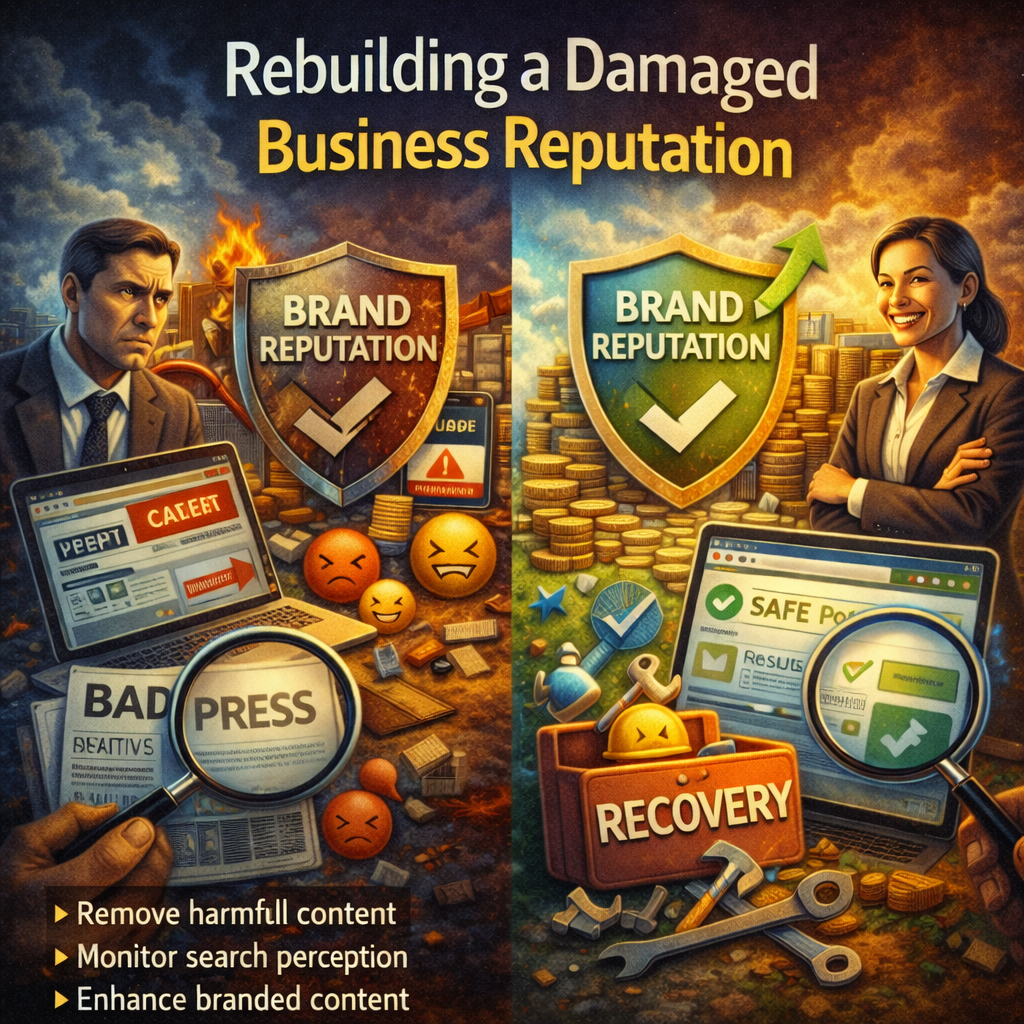
  • Rebuilding a Damaged Business Reputation

    Rebuilding a Damaged Business Reputation

    Every business, no matter how established or reputable, faces moments when its image takes a hit. A negative review that gains traction, a social media controversy, or an unsatisfied client can spiral into a major reputational challenge. The impact of a damaged business reputation can be long-lasting, influencing customer trust, stakeholder confidence, and even future revenue. Business leaders often realize that reputation recovery requires not only public relations skills but also strategic planning and consistent brand management. The journey to rebuild a brand’s credibility begins with acknowledging the issue and taking decisive action.

    Rebuilding a damaged business reputation isn’t about erasing past mistakes it’s about demonstrating change, transparency, and accountability. This blog explores the essential steps and strategies that organizations can take to recover their credibility and strengthen brand perception. From understanding the causes of reputational damage to implementing a proactive online reputation management plan, each section will offer practical insights for sustainable improvement. For businesses seeking professional guidance, Aiplex ORM provides specialized reputation management services tailored to restore trust and protect digital presence effectively.

    Understanding Business Reputation: What You Need to Know

    A company’s reputation is the public perception of its character, trustworthiness, and overall value in the market. It influences customer decisions, investor confidence, and partnership opportunities. The foundation of a strong business reputation lies in consistent ethical practices, transparency, and customer satisfaction. When these elements are disrupted through poor service, public scandals, or misinformation the damage can ripple across all aspects of a business. Understanding what reputation truly means is the first step in rebuilding it with precision and purpose.

    A business reputation evolves continuously, shaped by online reviews, social media presence, and media coverage. With digital platforms amplifying every opinion, even a minor issue can escalate quickly. This interconnected environment means that reputation management isn’t optional, it’s essential. Companies that monitor their reputation actively are better prepared to respond swiftly to emerging issues. By investing in strategic reputation monitoring tools and professional ORM services, businesses can safeguard their image while reinforcing trust with customers and stakeholders alike.

    Key Factors Influencing Business Reputation

    Several elements contribute to how the public perceives a company. Customer experience remains at the forefront—consistent quality and responsive service create trust and loyalty. Transparency in operations and communication helps reinforce integrity, while positive media coverage boosts credibility. Conversely, unethical practices, unaddressed complaints, and inconsistent messaging can damage the most established brands. Understanding these factors enables companies to strengthen weak areas before they lead to reputational crises.

    Another influential factor is employee advocacy. Employees are often the first ambassadors of a company’s values. When treated fairly and aligned with corporate goals, they naturally promote the brand positively. Negative employee reviews or poor workplace culture, however, can tarnish an organization’s reputation. To prevent this, leadership must invest in internal communication, satisfaction, and ethical culture-building to maintain a strong brand identity from within.

    The Role of Online Presence in Reputation Recovery

    Digital visibility shapes how the public perceives a business. A positive online presence can act as a shield against temporary crises, while a weak one leaves brands vulnerable to misinformation. Businesses should maintain optimized websites, active social media profiles, and updated listings to reinforce credibility. Engaging with audiences online also provides opportunities to showcase transparency and responsiveness, both crucial during recovery phases.

    Online reputation management (ORM) plays a critical role in maintaining this digital credibility. Professional ORM services like those offered by Aiplex ORM can help suppress negative content, highlight positive brand stories, and monitor sentiment trends across platforms. Through data-driven strategies, ORM ensures that a company’s narrative remains authentic and aligned with its goals while countering damaging content efficiently.

    Common Causes of Business Reputation Damage

    Reputation issues often stem from a combination of internal and external factors. Internal causes include poor customer service, product failures, or lack of accountability. External factors might involve false news, social media backlash, or association with controversial figures. Recognizing the root causes early enables timely intervention and prevents escalation.

    Sometimes, businesses suffer from reputational damage due to lack of crisis communication strategies. When organizations fail to respond promptly or effectively to negative publicity, they inadvertently deepen public mistrust. Proactive planning, regular audits, and communication transparency can help businesses prepare for and mitigate such crises before they cause irreparable harm.

    How Consumer Trust Impacts Reputation Restoration

    Trust is the foundation of every successful brand. Once broken, rebuilding it requires patience, authenticity, and consistent communication. Companies that openly acknowledge their mistakes and demonstrate tangible improvements are more likely to regain consumer confidence. Genuine engagement responding to reviews, addressing complaints, and keeping promises helps reinforce credibility over time.

    Rebuilding consumer trust also involves aligning brand actions with customer expectations. Businesses must ensure that their values and behavior reflect their promises. For instance, sustainability claims should be backed by measurable practices. When customers witness integrity in action, trust naturally returns. ORM strategies can amplify these efforts by highlighting positive developments across digital channels.

    Measuring Reputation Health Over Time

    To rebuild effectively, companies need measurable insights into their current reputation status. Key performance indicators (KPIs) such as sentiment analysis, customer satisfaction scores, and media coverage help track progress. These metrics provide a clear understanding of what’s working and where further improvement is needed. Regular reputation audits are therefore an integral part of the recovery process.

    Partnering with professional ORM experts allows businesses to track reputation data in real-time. Aiplex ORM, for instance, provides analytical tools and actionable reports that guide decision-making. Continuous monitoring not only helps in recovery but also ensures the long-term maintenance of a positive brand image across digital platforms.

    Steps to Rebuild a Damaged Business Reputation

    Rebuilding a business reputation demands a structured approach combining internal reform, communication strategy, and digital optimization. Each step plays a critical role in restoring trust and enhancing visibility. Below are the essential strategies every company should adopt to ensure sustainable reputation recovery.

    Step 1: Acknowledge and Assess the Damage

    The first step in rebuilding reputation is to face the issue head-on. Companies must identify what caused the damage, how it spread, and what its current impact is. This includes analyzing customer feedback, media reports, and social media sentiment. Avoiding or denying responsibility often worsens public perception.

    An honest assessment enables leadership to craft a genuine response strategy. Admitting mistakes where necessary shows integrity and accountability—qualities that audiences respect. Once the damage is mapped out, businesses can prioritize corrective measures that align with their brand values and stakeholder expectations.

    Step 2: Strengthen Internal Communication and Culture

    Employees are key contributors to reputation restoration. Transparent communication ensures that all internal teams understand the company’s vision and their roles in the recovery process. Regular meetings, updates, and leadership involvement build collective responsibility and motivation.

    Improving workplace culture is equally essential. Encouraging ethical behavior, celebrating transparency, and rewarding accountability reinforces positive values across the organization. When internal morale is strong, external communication becomes more authentic and persuasive.

    Step 3: Implement a Proactive PR and Communication Strategy

    Public relations plays a pivotal role in rebuilding reputation. Crafting a consistent and empathetic communication plan allows the company to control its narrative. This includes publishing press releases, sharing updates, and addressing concerns directly through official channels. Clarity and consistency in messaging build public confidence.

    Leveraging digital communication social media engagement, blog content, and thought leadership can reshape brand perception. When companies provide valuable, relevant information, they shift focus from past mistakes to future goals. Strategic storytelling and expert media relations further accelerate recovery.

    Step 4: Engage with Customers Authentically

    Customer relationships define the success of any reputation recovery strategy. Engaging sincerely with customers—through feedback surveys, personalized responses, and service improvements—creates a renewed sense of trust. Acknowledging and addressing customer pain points demonstrates a brand’s dedication to improvement.

    Social media engagement should emphasize listening over broadcasting. By showing empathy and responsiveness, businesses humanize their image. Turning negative reviews into opportunities for learning and service enhancement transforms dissatisfied customers into loyal advocates.

    Step 5: Partner with Professional ORM Services

    Digital reputation challenges often require specialized expertise. Professional ORM services, like those offered by Aiplex ORM, help businesses monitor, manage, and repair their online image efficiently. ORM experts analyze online sentiment, manage search engine results, and promote positive narratives that reflect brand authenticity.

    By integrating ORM into long-term communication strategy, businesses can prevent future crises while maintaining consistent visibility. The right ORM partner not only mitigates existing damage but also builds a resilient online identity capable of withstanding future challenges.

    Why Choose Aiplex ORM for Business Reputation Management

    Aiplex ORM specializes in restoring and managing corporate and personal reputations with precision and transparency. Their expertise spans proactive monitoring, content optimization, and crisis management all designed to protect and enhance a brand’s online image. The team uses advanced analytics and strategic communication to counter negative publicity and promote positive visibility.

    Partnering with Aiplex ORM ensures access to tailored solutions that align with your brand’s goals. Whether it’s recovering from negative reviews or improving digital sentiment, Aiplex ORM’s data-driven approach guarantees measurable outcomes. Their reputation management services empower organizations to regain trust, rebuild credibility, and sustain long-term brand integrity.

    Conclusion

    Rebuilding a damaged business reputation requires strategy, patience, and commitment. The process goes beyond fixing public perception—it involves reforming organizational values, enhancing communication, and building genuine connections with stakeholders. Businesses that approach reputation recovery with authenticity and structure often emerge stronger and more resilient.

    With professional guidance from Aiplex ORM, companies can navigate the complexities of reputation management with confidence. Their comprehensive ORM solutions not only restore lost credibility but also establish a lasting foundation for growth and trust. A strong business reputation is an investment one that ensures sustainable success, credibility, and customer loyalty for years to come.


  • Common Business Reputation Mistakes to Avoid

    Common Business Reputation Mistakes to Avoid

    A strong business reputation can propel a brand toward long-term success, while a single misstep can erode years of trust and credibility.

    Whether you are a small business owner or managing a global enterprise, maintaining a positive business reputation is no longer optional. Customers, investors, and partners often form their opinions based on what they read, see, and hear about your company. This blog explores the most common mistakes businesses make that can harm their brand image and offers insights to help you protect your reputation and earn the trust of your stakeholders.

    Reputation management is a continuous process that requires vigilance, consistency, and strategic communication. In this article, we will break down key areas where companies often falter—ranging from ignoring feedback to mishandling crises—and provide actionable recommendations. By understanding these pitfalls and implementing effective business reputation management strategies, you can safeguard your company’s image. If you need professional support in strengthening your brand reputation, connect with Aiplex ORM, a leading online reputation management company.

    Understanding the Foundation of Business Reputation

    A business reputation is not built overnight it reflects the cumulative perception formed by customers, employees, partners, and the public. Before exploring the common mistakes to avoid, it is crucial to understand what drives and sustains a company’s image. Several key factors influence how your reputation develops and evolves, including transparency, communication, corporate responsibility, and customer engagement. Recognizing these foundational elements can help you anticipate potential challenges and strengthen your overall brand standing.

    Beyond perception, a solid reputation also enhances tangible outcomes like customer loyalty, investor confidence, and talent acquisition. Companies that prioritize integrity and consistency across their operations are more likely to retain credibility even during challenging times. Let’s explore the essential components that influence business reputation and how they interconnect with your growth strategy.

    1. Transparency and Accountability

    Transparency and accountability form the cornerstone of a positive business reputation. When companies openly share their policies, acknowledge mistakes, and take responsibility for their actions, they establish trust with customers and stakeholders. Concealing information or deflecting blame can lead to long-term damage that is difficult to repair. Businesses that practice open communication, both internally and externally, signal integrity and reliability.

    On the other hand, organizations that fail to maintain transparency often face skepticism, misinformation, and negative publicity. Adopting clear communication practices—such as publishing regular updates, issuing honest press releases, and addressing public concerns—helps in maintaining credibility. Ensuring that your leadership and teams understand this value is essential to building a resilient reputation.

    2. Customer Experience and Engagement

    A business’s reputation largely depends on how well it treats its customers. Every touchpoint—from product quality to customer service—affects how people perceive your brand. Neglecting customer engagement or ignoring feedback can lead to dissatisfaction, negative reviews, and social media backlash. Positive interactions, however, foster advocacy and strengthen your brand image.

    Companies that prioritize consistent, empathetic engagement create loyal communities of supporters. Responding to reviews, addressing complaints, and improving services based on feedback demonstrate that you value your customers. This proactive approach not only enhances customer experience but also protects and elevates your overall business reputation.

    3. Ethical Business Practices

    Ethical operations are non-negotiable for maintaining a sustainable business reputation. Consumers are increasingly attentive to corporate behavior, expecting honesty, fairness, and responsibility. Unethical decisions such as misleading advertising or exploiting workers can rapidly destroy brand credibility. Adhering to ethical standards builds public trust and long-term brand resilience.

    Promoting ethics internally also nurtures a healthy work culture. Employees who see their organization operating with integrity become brand advocates themselves. By embedding ethics into your decision-making process, you ensure consistency between your company’s promises and actions—one of the most vital aspects of reputation management.

    4. Crisis Management Preparedness

    No organization is immune to crises. Whether it’s a data breach, public controversy, or operational failure, how you respond determines the longevity of your business reputation. Many companies underestimate the importance of preparedness, resulting in delayed, inconsistent, or defensive reactions that worsen public perception. Having a robust crisis management plan in place ensures swift and strategic action.

    Effective crisis management includes timely communication, factual updates, and empathy toward affected parties. Brands that respond transparently and take corrective measures quickly are more likely to regain trust. Establishing an internal crisis response team can help your company navigate complex situations without losing stakeholder confidence.

    5. Online Presence and Review Management

    In a digital-first environment, your online reputation often forms the first impression for potential clients and partners. Ignoring social media activity, reviews, or mentions can lead to misrepresentation of your brand. Businesses must actively monitor their online presence to ensure accuracy, consistency, and responsiveness.

    Managing online reviews and feedback strategically contributes significantly to your overall business reputation. Acknowledging both positive and negative reviews shows commitment to customer satisfaction. Tools and services, such as those offered by Aiplex ORM, help businesses maintain a positive digital footprint while mitigating potential reputation risks.

    Common Business Reputation Mistakes to Avoid

    Even well-established brands are not immune to reputation pitfalls. Understanding what to avoid is as crucial as knowing what to do right. The following sections outline key errors that can jeopardize your company’s image and provide insights into how to steer clear of them.

    1. Ignoring Customer Feedback

    Many businesses underestimate the power of customer feedback. Ignoring or dismissing feedback signals arrogance or indifference, both of which can alienate your audience. Whether it’s a single complaint on social media or a recurring issue reported through support channels, every piece of feedback offers valuable insight into how your company is perceived.

    Instead of avoiding criticism, embrace it as an opportunity to improve. Responding professionally to concerns and implementing visible changes builds loyalty and shows commitment to excellence. Customers who feel heard often turn into strong advocates, improving your reputation organically over time.

    2. Overpromising and Underdelivering

    Setting unrealistic expectations is a common yet damaging mistake. Overpromising to attract attention may yield short-term gains, but failing to deliver on those promises erodes credibility. Whether it involves product quality, delivery timelines, or service performance, unmet expectations can lead to negative reviews and public dissatisfaction.

    To maintain a trustworthy business reputation, be clear about what you can deliver and always exceed that baseline. Honest communication establishes reliability, while consistency strengthens long-term trust. Sustainable growth is built on meeting promises, not on exaggerated claims that disappoint your customers.

    3. Neglecting Employee Advocacy

    Employees are often overlooked as brand ambassadors. Their opinions, behavior, and satisfaction levels directly impact your company’s public perception. Ignoring employee welfare, engagement, or feedback can result in low morale, poor service quality, and negative reviews on employer rating platforms.

    Encouraging employee advocacy not only improves workplace culture but also enhances your reputation externally. Empower your teams to share their positive experiences and achievements. An engaged workforce naturally reflects professionalism and care—key factors in reinforcing your company’s reputation.

    4. Poor Social Media Management

    Social media platforms are powerful tools for building or breaking reputations. A lack of strategy, delayed responses, or tone-deaf messaging can quickly spiral into a public relations crisis. Companies that neglect their social presence risk losing control over their narrative.

    Developing a clear social media policy and consistent engagement routine helps manage your online reputation effectively. Monitor conversations about your brand, address misinformation, and ensure all communication aligns with your values. Strategic use of social media can transform potential risks into opportunities for connection and growth.

    5. Mishandling Negative Publicity

    Every organization encounters negative publicity at some point. The real test lies in how you handle it. Attempting to hide issues or respond defensively often amplifies criticism. Transparency, empathy, and swift corrective action are the hallmarks of effective damage control.

    When faced with negative attention, acknowledge the issue, apologize if necessary, and communicate your plan for resolution. Demonstrating accountability can convert a crisis into an opportunity for rebuilding trust. Partnering with experts like Aiplex ORM ensures your brand’s reputation is managed professionally and proactively.

    Why Choose Aiplex ORM for Business Reputation Management

    Maintaining a stellar business reputation requires constant monitoring, communication, and strategic action. Aiplex ORM specializes in helping brands protect, enhance, and repair their online and offline reputations. With advanced analytics, real-time monitoring, and tailored strategies, Aiplex ensures that your brand narrative remains positive and authentic.

    Whether you’re dealing with negative reviews, misinformation, or brand image challenges, Aiplex ORM provides comprehensive reputation management solutions. From proactive monitoring to crisis response, their expert team ensures your business maintains credibility across all platforms. Partnering with Aiplex gives you peace of mind, knowing your brand is represented accurately and positively at every touchpoint.

    Conclusion

    A strong business reputation is one of the most valuable assets your company can possess, Avoiding common mistakes such as ignoring feedback, overpromising, or mishandling crises is essential for sustainable success. Reputation management demands transparency, ethical behavior, and consistent engagement across all channels. By learning from others’ missteps and implementing robust reputation strategies, you can build trust and maintain long-term growth.

    If your organization seeks to strengthen its public image or recover from recent challenges, Aiplex ORM offers end-to-end business reputation management services designed to suit your unique needs. Visit Aiplex ORM today to explore how their expertise can help you maintain a positive, lasting brand reputation.


  • Business Reputation Tips for Lasting Trust

    Business Reputation Tips for Lasting Trust

    A strong business reputation isn’t just about good publicity it’s the foundation of long-term trust between a company and its audience. Imagine potential clients searching your brand online, seeing consistent positive reviews, authentic engagement, and responsible responses to feedback.

    That sense of reliability becomes the silent force that drives conversions and partnerships. A solid business reputation reflects credibility and professionalism, influencing every decision customers make about your brand.

    In this blog, we’ll explore the most effective business reputation tips that help brands nurture loyalty and authority over time. From maintaining transparency to leveraging digital tools for reputation monitoring, you’ll find actionable insights to enhance your brand’s trustworthiness. We’ll also see how working with experts like Aiplex ORM can simplify and strengthen your reputation management strategy. Let’s uncover how to build trust that lasts beyond a single transaction.

    Key Factors to Understand Before Strengthening Business Reputation

    Before implementing strategies to enhance your business reputation, it’s essential to understand the elements that shape public perception. Reputation management goes beyond social media responses—it’s about consistency, communication, and accountability across every touchpoint. Here are some key aspects every organization should grasp before taking action.

    1. The Role of Transparency in Building Trust

    • Transparency is the cornerstone of business reputation. Customers are quick to spot inconsistencies, and transparency ensures your brand’s communication remains honest and clear. Being upfront about challenges or mistakes not only humanizes your brand but also strengthens your audience’s confidence.
    • When companies communicate openly whether about pricing, product limitations, or service delays they showcase accountability. This proactive approach builds resilience in public perception, ensuring minor setbacks don’t escalate into full-blown PR issues.

    2. The Power of Consistent Branding

    • Consistency in messaging, tone, and visual identity enhances your brand’s recognition and reliability. A consistent image tells customers they can expect uniform quality and values every time they interact with your business.
    • This alignment between internal culture and external communication reinforces credibility. Whether it’s your website, social channels, or customer support, maintaining consistency ensures your audience sees professionalism at every step.

    3. Customer Feedback as a Growth Tool

    • Customer feedback isn’t just for troubleshooting it’s a roadmap for continuous improvement. By analyzing patterns in reviews and testimonials, businesses can identify areas of strength and improvement.
    • Actively responding to feedback both positive and negative demonstrates commitment to customer satisfaction. Encouraging reviews and following up with clients shows that you value their input, fostering long-term loyalty.

    4. The Impact of Employee Advocacy

    • Employees are ambassadors of your brand reputation. When they share positive experiences and company achievements, it creates an authentic narrative that customers trust.
    • Encouraging employee participation in brand storytelling amplifies credibility. From LinkedIn updates to workplace culture posts, employee-driven content reflects a strong, transparent organization aligned around shared values.

    5. Monitoring Online Presence

    • Tracking mentions, reviews, and brand sentiment online helps businesses stay ahead of potential risks. With real-time monitoring tools, you can address concerns before they spread or damage perception.
    • Active reputation monitoring through ORM platforms ensures consistency in responses and protects your brand from misinformation. This vigilance is crucial for maintaining long-term credibility and consumer confidence.

    Essential Business Reputation Tips for Long-Term Trust

    Now that the foundational elements are clear, let’s dive into actionable tips to strengthen and sustain a stellar business reputation.

    1. Prioritize Authentic Engagement

    • Authenticity builds emotional connections. Rather than scripted replies or automated responses, genuine conversations with your audience build lasting goodwill. Customers appreciate when brands listen, empathize, and act.
    • Personalized responses and transparent communication can turn even a dissatisfied customer into an advocate. Authentic engagement creates an ecosystem of trust, showing that your brand values relationships over transactions.

    2. Deliver on Promises

    • Trust grows when businesses consistently deliver on what they promise. Missed commitments erode confidence quickly, while reliable execution fosters brand loyalty.
    • Set realistic expectations and communicate clearly about timelines and deliverables. When unforeseen challenges arise, inform customers promptly proactive communication often matters more than perfection itself.

    3. Encourage Positive Reviews and Testimonials

    • Online reviews are today’s word-of-mouth marketing. Encouraging satisfied clients to share their experiences enhances your credibility across digital platforms.
    • To make the process easy, provide direct links or post-purchase prompts for leaving feedback. Respond to reviews graciously, showing appreciation for every contribution this reinforces a sense of community around your brand.

    4. Showcase Corporate Social Responsibility (CSR)

    • Modern consumers are drawn to brands that care about more than profits. CSR initiatives like sustainability, community involvement, or ethical sourcing strengthen emotional ties with customers.
    • Promoting your CSR activities through authentic storytelling demonstrates empathy and integrity. These actions reinforce your brand’s moral standing and deepen audience trust.

    5. Maintain a Strong Crisis Management Plan

    • No brand is immune to mistakes, but how you respond defines your reputation. Having a crisis response plan ensures your team reacts swiftly and strategically.
    • Crisis management frameworks that include clear communication channels and designated spokespersons prevent chaos. A structured approach helps you regain control of the narrative and reassure stakeholders.

    6. Invest in Reputation Management Tools

    • Digital tools streamline monitoring, analysis, and reporting. From tracking sentiment to identifying high-risk keywords, automated systems enhance efficiency.
    • Platforms like Aiplex ORM specialize in real-time reputation tracking and response management. Leveraging such services ensures consistent vigilance and timely interventions that preserve brand integrity.

    7. Align Leadership with Brand Values

    • When company leaders embody the brand’s values, it strengthens authenticity. Stakeholders are inspired when leadership acts as role models for ethics and communication.
    • Encouraging transparent leadership communication fosters internal and external trust. Employees and clients alike respond positively to leaders who prioritize integrity and openness.

    8. Educate and Empower Your Team

    • Every employee plays a role in maintaining business reputation. Equipping them with communication guidelines and brand values ensures consistent representation.
    • Training programs that emphasize empathy and brand voice cultivate professionalism. Empowering employees to handle customer interactions confidently contributes to a cohesive reputation strategy.

    Why Choose Aiplex ORM for Business Reputation Management

    Aiplex ORM offers specialized expertise in maintaining and improving brand perception across online channels. Their advanced monitoring tools, analytical insights, and strategic communication support businesses in safeguarding credibility. By combining technology with personalized strategy, Aiplex ORM ensures that every aspect of your brand image remains aligned with your goals.

    What sets Aiplex ORM apart is its proactive approach. Instead of waiting for issues to escalate, their team identifies and mitigates risks in real-time. From review management to crisis communication, Aiplex ORM provides a complete suite of services designed to protect and elevate your business reputation. Collaborating with their experts means gaining peace of mind that your digital presence remains both resilient and respected.

    Conclusion

    Building and maintaining a business reputation takes time, dedication, and consistent effort. Every interaction, whether with customers, employees, or partners, shapes how your brand is perceived. By focusing on authenticity, accountability, and proactive engagement, you can create a foundation of lasting trust.

    With expert support from Aiplex ORM, businesses can manage their reputations with precision and confidence. Investing in professional reputation management isn’t just about image it’s about securing long-term growth and credibility in an ever-evolving marketplace.