
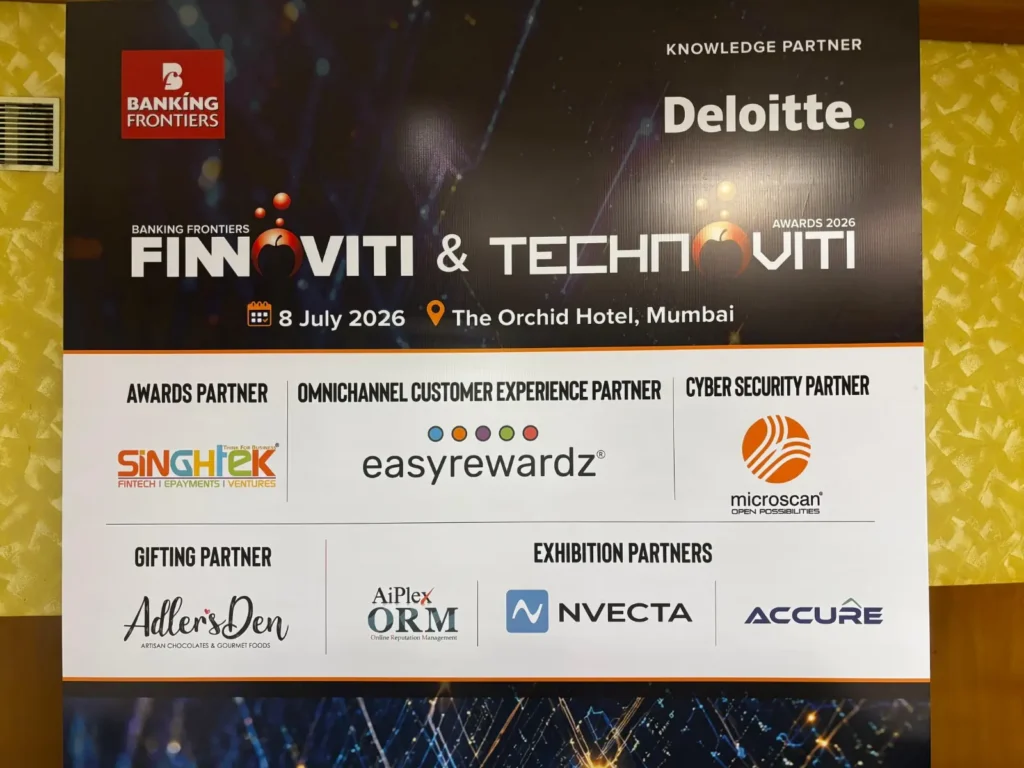
Every year a few industry gatherings manage to surface what a sector is genuinely worried about — not the topics printed on the agenda, but the ones that fill the space between sessions. Technoviti 2026 and Finnoviti 2026, organised by Banking Frontiers, was one of those. In the presence Arjun Bhaskaran Prasanna Lohar Prashanth Pereira Babu Nair Manoj Agrawal – in Quest of Clarity Kailash Purohit Wilhelm Singh Pritesh Priyanka Stalin Saldhana Pramoud P Jadhao Santosh B. Anmol Raina the event resulted in highly informative & insightful discussion.
AiPlex participated as an Exhibition Sponsor, and across the event our team spoke with leaders from banks, NBFCs, fintechs, regulators, technology partners and the wider BFSI ecosystem. The platform brought together conversations on innovation, cybersecurity, fraud prevention, digital trust and the future of financial services. One thread ran through more of those conversations than any other: fraud — not as an abstract risk category owned by a compliance function, but as an immediate, fast-moving, brand-damaging operational problem.
Institutions are no longer asking whether they will be impersonated online. They are asking how quickly they can find out, and how quickly they can make it stop.
The conversation that dominated the floor
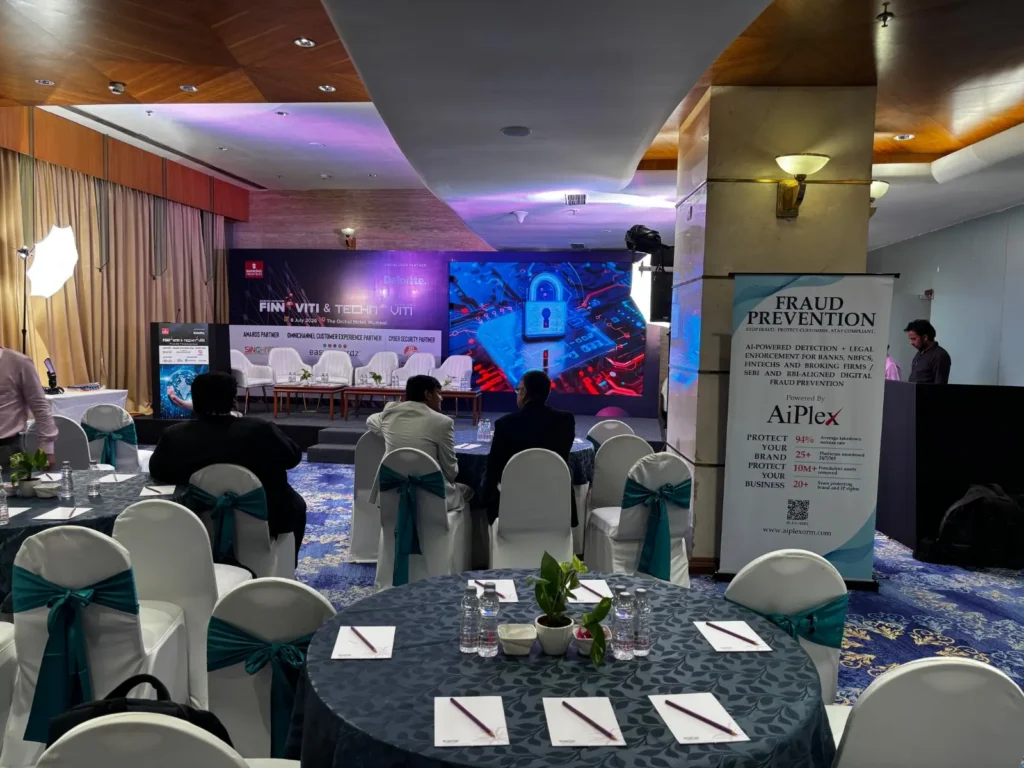
What made this year’s edition distinct was a shift in framing.
Fraud prevention has traditionally been discussed as a transaction-layer problem — anomaly detection on payments, rules engines on card activity, velocity checks on account openings. Those conversations still happened, and they remain essential. But running alongside them was a second, newer discussion: fraud that never touches a bank’s systems at all.
A cloned website. A fake mobile application. A social media account carrying a bank’s logo. A messaging group promising loan approvals in the name of an NBFC that has no idea the group exists. None of these breaches a firewall. None triggers a transaction alert. And yet all of them cost institutions money, customers, and — most durably — trust.
That gap between where fraud now originates and where most fraud controls are pointed was the through-line of the event.
About Technoviti and Finnoviti
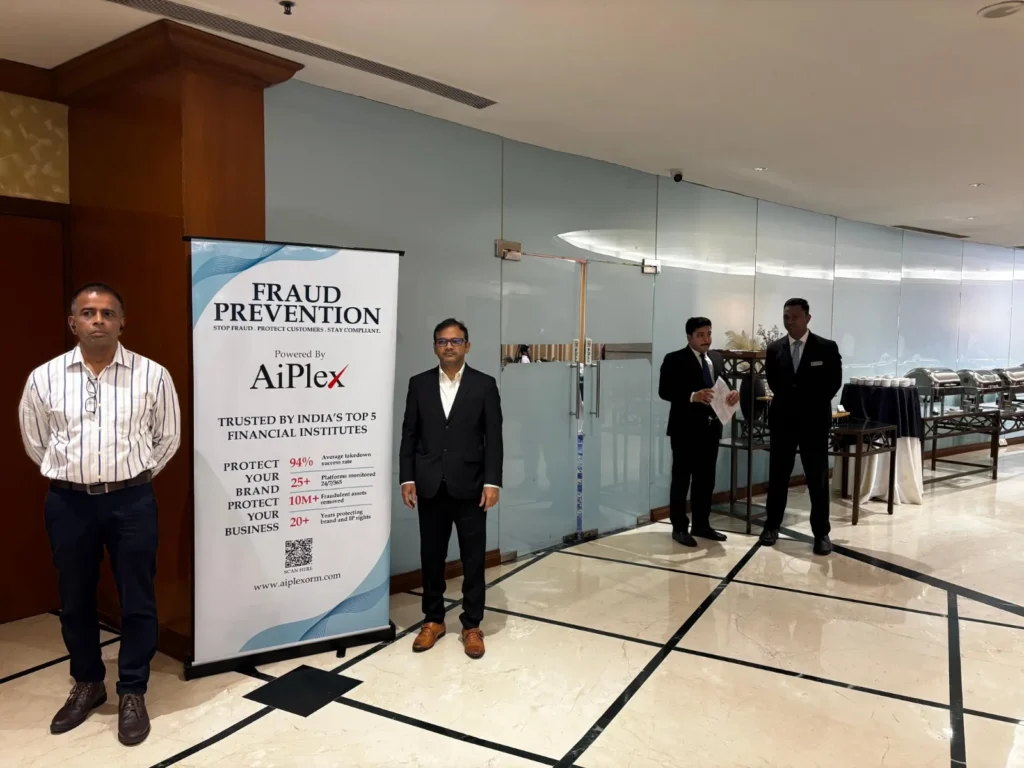
Banking Frontiers has spent years building a media and engagement ecosystem around Indian financial services, and its event properties reflect that positioning. Technoviti and Finnoviti are innovation-recognition platforms. They exist to identify and celebrate what institutions are actually building, rather than to serve as another stop on a general conference circuit.
That distinction shapes the quality of the room. An awards-anchored event attracts the people who own the projects, not only the people who market them. Conversations at exhibitor booths reflect it: fewer general enquiries, more specific problems, and a noticeably higher tolerance for technical detail.
The attendee mix matters too, and it explains why the fraud conversation went where it did. With banks, NBFCs, fintechs, regulators and technology partners in the same space, a single discussion could move from a regulatory expectation, to an operational constraint at a mid-sized NBFC, to a technical detection method from a technology vendor — without anyone having to leave the room.
That cross-section is rarer than it sounds. Fraud prevention suffers when it is discussed only among security teams, or only among compliance teams, or only among vendors. Here, all three were within a few metres of each other.
Recognising innovation in BFSI
The awards component is central to both properties rather than an evening add-on. Technoviti and Finnoviti recognise institutions and teams that have deployed genuine innovation in financial services — implementations and product thinking that produced measurable outcomes rather than press releases.
For an exhibitor, the awards serve a practical function beyond ceremony. The categories drawing the most entries in a given year tend to predict the following year’s operational priorities. Congratulations to every award winner recognised at Technoviti 2026 and Finnoviti 2026 for their achievements and their contributions to the sector.
Fraud in Indian banking: the 2026 landscape
India’s financial services sector has completed one of the fastest digital transitions of any major economy. Account opening moved to mobile. Payments moved to UPI. Lending moved to app-based journeys with minute-level disbursal. Customer service moved to chat interfaces and social channels.
Each of those transitions delivered real gains in reach and cost-to-serve. Each also created new surface area for fraud.
The critical structural change is this: a financial institution’s brand now lives in places the institution does not control. A customer’s relationship with their bank is mediated through app stores, search results, social platforms, messaging apps and advertising networks. A fraudster does not need to compromise the bank to exploit that relationship. They only need to occupy one of those unowned surfaces convincingly enough.
The layer that never gets reported
Fraud statistics across Indian financial services show growth in both incident volume and sophistication, with digital channels accounting for a rising share of cases. But what the reported numbers consistently understate is the layer beneath them.
When a customer is defrauded by a fake application carrying a bank’s logo, the incident may never enter that bank’s fraud reporting at all. The money moved through a channel the institution never touched. No system of theirs was compromised. No transaction of theirs was anomalous. The institution frequently learns about the incident only when the customer complains publicly — which is the point at which it becomes a reputation event as well as a fraud event.
This is a measurement problem with operational consequences. Institutions allocate fraud-prevention resources against the incidents they can see. The category they cannot see is the one growing fastest.
Where traditional controls fall short
Conventional fraud infrastructure is built on a reasonable assumption: that fraud involves the institution’s own systems and can therefore be detected within them. Transaction monitoring, device fingerprinting, behavioural biometrics and rules engines are all designed to catch anomalies inside the perimeter. Against the threats they were built for, they work.
Impersonation fraud defeats this design not by evading the controls but by operating entirely outside their field of view. There is no anomalous transaction to flag when a victim voluntarily transfers money to someone they believe is their bank. There is no unusual device signature when the fraudulent application is not the bank’s application at all. The authentication was never bypassed, because it was never invoked.
Detection for this category has to sit outside the institution — monitoring the open web, app ecosystems, social platforms and messaging channels for abuse of the brand itself. That is a fundamentally different capability from anything in the traditional fraud stack, and it is one most institutions have not historically owned.
Where fraud prevention meets brand reputation
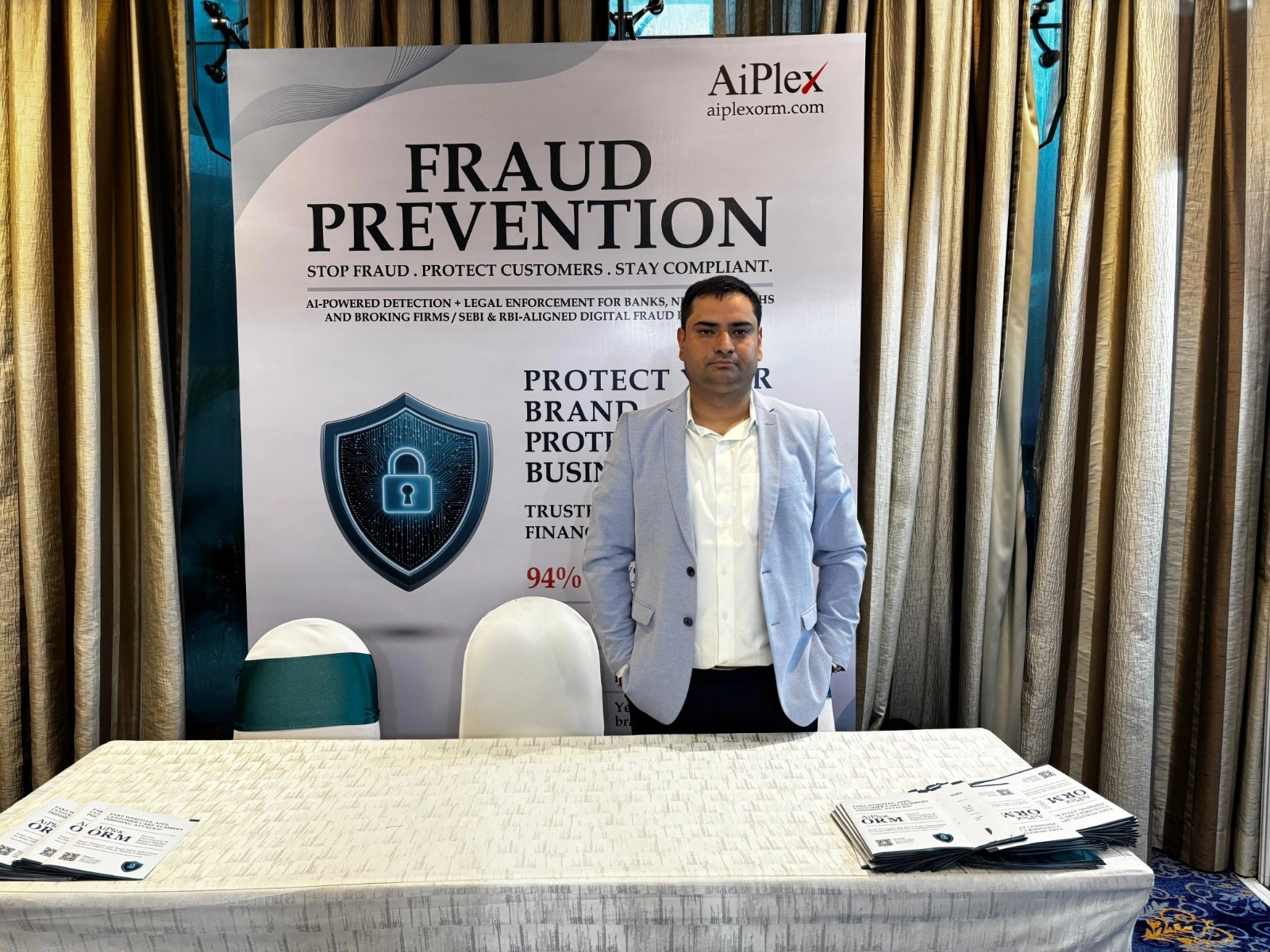
This is the connection that generated the most engaged conversations at our booth, and it is the one AiPlex’s BFSI practice is built around.
Every fraud incident is also a trust incident
Institutions typically route fraud and reputation into separate functions. Fraud sits with risk, security or operations. Reputation sits with marketing or corporate communications. The two teams often use different tools, report through different lines, and meet properly only during a crisis.
Impersonation fraud does not respect that boundary. A fake banking application is simultaneously a fraud vector and a brand event. A deepfaked executive endorsement is simultaneously a scam enabler and a communications crisis. Handling them through separate workflows produces one of two predictable failures: the fraud team removes the immediate threat while narrative damage continues unmanaged, or the communications team responds publicly while the fraudulent asset remains live — occasionally driving additional traffic to it.
The damage starts before the first victim
There is a window — often days, sometimes weeks — between a fraudulent asset appearing and a victim reporting it. During that window, the asset accumulates search visibility, social engagement and apparent legitimacy.
The institution’s brand is being degraded throughout this period, silently. Customers who encounter the fake and correctly identify it as fraudulent still adjust their perception of the institution’s competence. Search engines index the fraudulent domain against the brand name. Social platforms surface the fake profile alongside the real one, sometimes in the same results.
By the time the first victim reports a loss, the reputational damage is already substantially done. The fraud response begins at the point where the reputation problem is already mature.
Why speed is the whole game
Every additional day a fraudulent asset stays live compounds three costs: more victims, deeper search and social entrenchment, and more remediation work downstream.
Speed is therefore the single most important variable in this category — more important than detection sophistication, and considerably more important than post-incident communications. An institution that detects a cloned site in six hours and removes it within a day faces a fundamentally different problem from one that detects it in three weeks. The second institution is not doing a worse job of the same task. It is doing a different, much harder task.
The regulatory lens
India’s regulatory framework has tightened steadily around fraud reporting timelines, customer liability and grievance redressal. The direction of travel is consistent: shorter reporting windows, clearer institutional accountability, and greater protection for customers who acted in good faith.
That trajectory has an operational consequence not always fully appreciated. When customer liability depends partly on how quickly an institution responded, response time stops being a service-quality metric and becomes a financial and compliance exposure.
An institution that cannot demonstrate active monitoring for brand abuse, and cannot show a documented enforcement process with measurable turnaround times, carries a risk that is increasingly difficult to defend — to regulators, and in customer disputes where the question of what the institution knew and when will be asked directly.
AiPlex at Technoviti and Finnoviti

AiPlex’s work sits precisely at the junction the event kept returning to. We are not a transaction-monitoring vendor and we do not compete with core fraud infrastructure. We address the layer outside the institutional perimeter — where a brand is used, misused and impersonated across the open web, app ecosystems, social platforms and messaging channels.
Technoviti and Finnoviti brought together exactly the decision-makers who own that problem, frequently without owning a dedicated capability for it. That made it the right room.
Our booth focused on the three capabilities that define our BFSI practice — AI-powered monitoring, techno-legal enforcement and rapid digital risk mitigation — presented as a connected workflow from detection through to removal, rather than as separate products.
The questions that came up most
Certain questions recurred often enough to be worth recording, because they map the sector’s current gaps better than any survey.
“How do we find out about a fake app or site before a customer tells us?” The most common question by a wide margin, and a direct acknowledgment that most institutions are operating reactively.
“How long does a takedown actually take?” Usually asked with visible scepticism, and usually by teams who have submitted platform reports and watched them sit unresolved for weeks.
“Who owns this internally?” Often asked rhetorically, and often answered with a pause. At many institutions the honest answer is that nobody owns it entirely.
“Does this cover regional languages and regional platforms?” A pointed and important question. Fraud targeting Indian financial customers frequently operates in regional languages on regional platforms. Monitoring that covers only English-language content on major global platforms will miss a substantial share of it, while producing reports that look reassuringly complete.
How AiPlex helps financial institutions fight fraud

AI-powered monitoring
The detection problem is fundamentally a scale problem. The surfaces requiring continuous observation — domains, app stores, social platforms, marketplaces, messaging channels, search results, paid advertising — generate volumes no manual team can cover.
AiPlex applies AI-driven detection across those surfaces, identifying unauthorised use of an institution’s brand assets, names, logos and identity markers. The objective is compressing time-to-detection from weeks to hours, because everything downstream depends on it. An excellent enforcement capability attached to slow detection still produces a slow outcome.
Coverage must extend to regional languages and regional platforms. Fraud aimed at Indian financial customers does not operate exclusively in English on global platforms, and monitoring built on the assumption that it does will systematically under-report while appearing thorough.
Techno-legal enforcement
Detection without enforcement is an alerting system, not a solution. This is where most institutional efforts stall.
Platform reporting mechanisms are inconsistent. A report filed through a standard channel may be actioned within hours or ignored indefinitely, and the difference frequently has less to do with the severity of the abuse than with how the report was constructed. Different platforms require different evidence, different legal grounding and different escalation paths. Hosting providers, domain registrars, app stores and social networks all operate distinct processes with distinct standards.
AiPlex’s techno-legal enforcement combines technical evidence-gathering with legal process — building the documentation each platform or intermediary requires, filing through the correct channel with the correct grounding, and escalating where a first-line report fails. The distinction is not cosmetic: a properly constructed enforcement action gets resolved, while a generic report frequently does not.
Enforcement also has to account for recurrence. Operators who are removed typically return, often within days, under slightly altered identities and domains. Effective enforcement anticipates this and treats each removal as part of a continuing process rather than a closed ticket.
Rapid digital risk mitigation
Between detection and successful takedown, an institution remains exposed. Mitigation is what happens inside that window: suppressing the fraudulent asset’s visibility, limiting its reach, and coordinating with the institution’s communications function on customer-facing response.
This is where the fraud–reputation link becomes operational rather than theoretical. Effective mitigation requires the enforcement action and the communications response to be coordinated, because they are addressing the same incident from two directions. Uncoordinated, they interfere with each other.
Online reputation management
Underlying all of it is the reputation layer. Fraud incidents leave residue — search results, social conversations, forum threads and coverage that persist long after the fraudulent asset itself is gone.
AiPlex’s ORM practice addresses that persistent layer, managing search visibility, sentiment and narrative around a financial institution’s brand so that a resolved fraud incident does not remain the most prominent thing about the institution’s name six months later.
The fraud vectors BFSI leaders are watching

Five categories came up repeatedly in conversations at our booth.
Deepfakes and synthetic identity fraud
Synthetic media has moved from novelty to operational threat, and two applications concern financial institutions most.
The first is identity-layer: synthetic faces and voices used to defeat video KYC and voice authentication. This is the version that gets the most attention, and institutions are actively investing in liveness detection and related countermeasures.
The second is brand-layer, and it is increasingly the more damaging: fabricated video or audio of an institution’s senior executives endorsing an investment scheme, announcing a product, or making statements they never made.
The second category is harder to defend against, because the target is not the institution’s authentication system — it is the customer’s trust in a familiar face. No security control the institution owns sits between a fabricated executive endorsement and the customer who sees it. By the time such a video is circulating, the damage mechanism is entirely reputational and the remedy is entirely a detection-and-takedown problem.
Fake apps, cloned websites and phishing domains
This remains the highest-volume vector, and the economics explain why.
A cloned banking website costs almost nothing to build and can be indistinguishable from the original to a non-technical customer. Fraudulent applications appear on third-party app stores and, occasionally, on official ones. Lookalike domains proliferate faster than most institutions can register defensive variants — a single brand name can generate hundreds of plausible misspellings, homoglyph substitutions and alternative extensions.
The asymmetry is brutal. The fraudster’s cost per attempt approaches zero. The institution’s cost per incident includes customer remediation, regulatory reporting, and brand repair that outlasts both.
Impersonation on social platforms
Fraudulent profiles using an institution’s name, logo and visual identity are now a persistent problem across every major platform. They operate in several modes: fake customer support handles that intercept complaints and harvest credentials, fake executive profiles that lend authority to investment scams, and fake official pages announcing offers that do not exist.
The customer-support variant is particularly effective because it exploits a genuine service gap. A frustrated customer posting a complaint publicly is actively looking for someone to respond. A fraudulent handle that replies within minutes will often be trusted over an official one that replies in a day. The fraudster is, in a narrow and uncomfortable sense, providing better service.
Investment and loan scams run under a brand name
Loan-approval scams and investment schemes conducted in an institution’s name — over messaging platforms and, increasingly, through paid social advertising — have become a major source of customer harm. The institution is entirely uninvolved in the transaction and frequently unaware of the campaign until victims begin surfacing.
For NBFCs this has become especially acute. Their brands carry enough recognition to lend credibility to a scam, while their monitoring capabilities are often lighter than those of large banks. The combination is precisely what a fraudster selects for.
Payments-layer social engineering
UPI’s scale and speed represent a genuine achievement and a genuine exposure. Social-engineering-led payment fraud — collect-request manipulation, QR code substitution, fraudulent merchant identities — continues to evolve in response to each countermeasure deployed against it.
The distinguishing feature of most of this fraud is that the transaction itself is legitimate from the system’s perspective: an authenticated user authorised a transfer. The fraud occurred in the persuasion that preceded it. That makes it a communications problem more than a payments-systems problem, which is uncomfortable for institutions whose fraud capabilities are concentrated in payments systems.
What this looks like in practice
The following is an illustrative scenario, constructed to show how the workflow fits together.
Consider a mid-sized NBFC with a consumer lending product and strong regional brand recognition.
A fraudulent operation registers a lookalike domain — the institution’s name with a minor spelling variation — hosting a convincing replica of the loan application journey. Simultaneously, a fraudulent Android application appears on third-party app stores using the institution’s logo and colour scheme. Paid social advertising in two regional languages drives traffic to both, promising rapid loan approval against an advance processing fee.
Detection. Monitoring flags the lookalike domain within hours of registration, and identifies the fraudulent application and the associated regional-language advertising campaign — the component most likely to be missed by English-only monitoring.
Evidence. Enforcement teams document the infringement: captures of the cloned interface, the trademark and brand asset misuse, hosting and registrar records, app store listing details, and the advertising campaign’s targeting parameters.
Enforcement. Actions proceed in parallel rather than sequentially — registrar and hosting provider action against the domain, app store takedown requests, and platform enforcement against the advertising campaign and its associated accounts. Sequential enforcement wastes the window; parallel enforcement closes it.
Mitigation. While enforcement runs, mitigation limits exposure — suppressing the fraudulent domain’s visibility against brand search terms, and coordinating with the institution’s communications team on a customer advisory issued through official channels.
Recurrence management. Monitoring continues against the operator’s identified patterns, on the working assumption that they will attempt to return under a variation.
Under this workflow, the exposure window is measured in days. Without it, the realistic alternative is that the institution learns of the operation when defrauded customers begin complaining — typically several weeks in. By then the fraudulent domain has search visibility against the brand name, the advertising campaign has run to completion, victim numbers are substantially higher, and the institution is simultaneously managing a fraud response, a regulatory reporting obligation and a public reputation event.
The difference between those two outcomes is not primarily technology. It is time-to-detection and enforcement capability.
A readiness checklist
Drawn from the gaps that surfaced most often in conversations across the event:
Establish clear internal ownership. Determine which function owns brand-impersonation fraud. If the honest answer is that it is split between security and marketing with no defined handoff, closing that gap is the first task.
Audit current visibility. Assess what proportion of your brand’s external surface is genuinely monitored — including regional languages, regional platforms, third-party app stores and messaging channels.
Measure enforcement turnaround. Take a known past incident and calculate the elapsed time from first appearance to full removal. That number is your current exposure window, and it is probably longer than expected.
Connect fraud and communications workflows. Ensure a detected impersonation incident triggers both an enforcement action and a communications assessment through a defined process, rather than an ad-hoc phone call.
Plan for recurrence. Treat takedowns as ongoing enforcement rather than closed tickets, and monitor for the return of known operators.
Document everything. Maintain records of monitoring coverage, detection times and enforcement actions. This matters increasingly for regulatory expectations and for customer dispute resolution.
Building digital trust in the AI era

The clearest takeaway from Technoviti 2026 and Finnoviti 2026 was a shift in how the sector frames the problem. The question is moving away from “how do we stop fraudulent transactions” and toward “how do we protect the trust our customers place in our brand, across surfaces we do not own.”
That is a harder question, and it does not resolve within the traditional fraud stack. It requires visibility outside the institutional perimeter, enforcement capability across platforms and jurisdictions, and an operational connection between fraud response and reputation management that most institutions have not yet built.
The institutions that navigate the next few years well will be those that treat their digital brand presence as infrastructure to be actively defended, rather than as a marketing asset that occasionally comes under attack.
Our sincere appreciation to the entire Banking Frontiers team, the organisers, speakers, jury members, partners, sponsors, exhibitors, delegates, and every visitor who stopped by our booth. Special thanks to Arjun Bhaskaran, Prasanna Lohar, Prashanth Pereira, Babu Nair, Manoj Agrawal, Kailash Purohit, Wilhelm Singh, Pritesh Priyanka, Stalin Saldhana, Pramoud P Jadhao, Santosh B. and Anmol Raina. Your conversations, insights and encouragement made the event genuinely memorable, and they continue to shape how we approach our work.
We look forward to continuing our mission of helping financial institutions strengthen fraud prevention and online reputation management through AI-powered monitoring, techno-legal enforcement and rapid digital risk mitigation.
Frequently asked questions
What are Technoviti and Finnoviti?
Technoviti and Finnoviti are innovation-recognition events organised by Banking Frontiers for India’s financial services sector. They bring together banks, NBFCs, fintechs, regulators and technology partners, and recognise institutions and teams that have deployed meaningful innovation in BFSI.
Who attended Technoviti 2026 and Finnoviti 2026?
The events drew leaders from across the BFSI ecosystem — banks, NBFCs, fintechs, regulators, technology partners, speakers, jury members, exhibitors and delegates. AiPlex participated as an Exhibition Sponsor.
What is techno-legal enforcement in fraud prevention?
Techno-legal enforcement combines technical evidence-gathering with legal process to remove fraudulent digital assets. Rather than filing a generic platform report, it involves documenting the infringement to the evidentiary standard each platform, registrar, hosting provider or app store requires, filing through the correct channel with appropriate legal grounding, and escalating where first-line reports fail. This produces substantially higher takedown success rates than standard reporting.
How does AI-powered monitoring detect banking fraud?
AI-powered monitoring continuously scans external surfaces — domains, app stores, social platforms, marketplaces, messaging channels, search results and advertising networks — for unauthorised use of an institution’s brand assets, names, logos and identity markers. Because these surfaces generate volumes no manual team can cover continuously, AI-driven detection is what makes comprehensive coverage practical. For Indian financial institutions, effective monitoring must include regional languages and regional platforms.
How does fraud prevention connect to online reputation management?
Brand-impersonation fraud is simultaneously a fraud event and a reputation event. A cloned website or fraudulent application harms customers financially while degrading trust in the institution’s brand. Handling these through separate workflows means either the fraudulent asset is removed while narrative damage continues unmanaged, or a public response is issued while the asset remains live. Integrated fraud prevention and ORM addresses both dimensions of the same incident.
How can a bank or NBFC get started with AiPlex?
AiPlex works with financial institutions on AI-powered monitoring, techno-legal enforcement, rapid digital risk mitigation and online reputation management. Engagements typically begin with an assessment of current brand exposure across external digital surfaces.
Protect your institution’s brand and your customers’ trust. AiPlex helps banks, NBFCs and fintechs detect brand impersonation early, enforce takedowns that hold, and manage reputation across the digital surfaces that matter most.